
(July 15, 2026): For health care practitioners, providers, and suppliers, the National Practitioner Data Bank (NPDB) represents one of the most significant and least understood forces in their professional lives. What began as an effort by Congress to track incompetent physicians has evolved into a massive, permanent repository of medical malpractice payments, disciplinary actions, and adverse privilege decisions.[1] A single entry in the NPDB can have serious career consequences, including the loss of hospital privileges, denial of credentialing, increased malpractice insurance premiums, exclusion from Medicare and Medicaid, and even the revocation of a medical license.[2]
I. The History and Legislative Origins of the NPDB:
A. Congress Creates the NPDB. The NPDB was passed by Congress as part of Title IV of the Health Care Quality Improvement Act (HCQIA) of 1986.[3] At the time, lawmakers perceived a growing national crisis in medical malpractice litigation and a pressing need to improve the quality of medical care. Congress made specific findings that "the increasing occurrence of medical malpractice and the need to improve the quality of medical care have become nationwide problems" and that "there is a . . . need to restrict the ability of incompetent physicians to move from State to State." [4]
A primary concern driving the legislation was the phenomenon of the "wandering physician," incompetent practitioners who would simply relocate from one state to another to evade malpractice payouts or disciplinary action, without disclosure or discovery by their new employers or licensing boards.[5] Congress also found that the threat of private money damages liability under federal antitrust law unreasonably discouraged physicians from participating in effective professional peer review, and therefore sought to provide both incentives and protection for such peer review activities.[6]
The NPDB was developed by the U.S. Department of Health and Human Services (HHS), Health Resources and Services Administration (HRSA), and the Bureau of Health Professions.[7] The NPDB is a web-based compendium of submissions by reporter entities containing information on medical malpractice payments and reportable adverse actions taken against health care practitioners, providers, and suppliers.
B. Early Implementation of the NPDB. The HCQIA established the NPDB as a central, confidential clearinghouse for collecting and releasing information on the professional competence and conduct of physicians and dentists.[8] After a four-year implementation period, the NPDB officially opened for business on September 1, 1990.[9] The system was transitioned to the internet in 1999, dramatically increasing its accessibility to eligible querying entities.[10]
C. Changes to the NPDB. Over the following decades, subsequent legislation significantly expanded the NPDB's scope and reach:
- 1987. Congress passed Section 1921 of the Social Security Act, authorizing the federal government to collect information concerning sanctions taken by state licensing authorities against all health care practitioners and entities, not just physicians and dentists.[11]
- 1996. Section 1128E of the Social Security Act, enacted as part of the Health Insurance Portability and Accountability Act (HIPAA) of 1996, established the Healthcare Integrity and Protection Data Bank (HIPDB) to combat health care fraud and abuse and requires reporting of final adverse actions by federal agencies and health plans.[12]
- 2010. The HIPDB was formally merged into the NPDB pursuant to Section 6403 of the Patient Protection and Affordable Care Act of 2010, creating a single, unified repository for all reportable adverse actions and malpractice payments.[13]
D. A System Under Scrutiny. While the original intent of the NPDB was to protect the public and improve the quality of health care, the benefits program has been widely criticized by legal scholars, physicians, and policy experts. As one researcher documented in the Harvard Journal on Legislation, the NPDB "distorts medical malpractice litigation and settlement -- harming defendant-physicians, plaintiff-patients, and insurers."[14] The NPDB’s "brooding shadow over medical malpractice has led many litigants and commentators to term it a 'blacklist,'" a characterization echoed by federal courts.[15]
II. What Must Be Reported to the NPDB?
The NPDB collects information on a wide range of actions, including, but not limited to, malpractice settlements and judgments, adverse peer-review actions, civil judgments, criminal convictions, and state licensure actions. Understanding what is (and what is not) reportable to the NPDB is the first critical step in protecting a health care practitioner’s career. By 2024, NPDB queries resulted in the disclosure of over 2.5 million reports, underscoring the extraordinary reach of this federal database into the credentialing and hiring decisions of every major health care institution in the country.[16] The primary categories of reportable actions are discussed below:
A. Medical Malpractice Payments. Any entity (including Medical malpractice payers), including hospitals and other health care entities that are self-insured, that makes a payment in settlement or satisfaction of a judgment in a medical malpractice action or claim must report it to the NPDB within 30 calendar days.[17] The report must include basic demographic information, the amount of the payment, a description of the settlement or judgment terms, and a narrative description of the acts or omissions and injuries upon which the action was based.[18] This narrative is capped at 4,000 characters, including spaces and punctuation. Characters exceeding the 4,000-character limit are not recorded in the report. Unfortunately, this limitation can effectively prevent the full complexity of a case from being accurately described.[19]
This reporting obligation applies even to nuisance settlements or settlements made by an insurer against the physician's wishes. The law presumes that "a payment in settlement of a medical malpractice action or claim shall not be construed as creating a presumption that medical malpractice has occurred," but the payment must still be reported.[20] According to data compiled from the American Medical Association (AMA), approximately 1 in 3 clinicians is sued for medical malpractice at least once during their career.[21] The average medical malpractice settlement in the United States is $1,689,901, while the median settlement is $750,000.[22]
B. Administrative Adverse Personnel Actions by Federal Agencies. Administrative adverse actions by federal agencies include "Personnel-related actions such as suspensions without pay, reductions in pay, reductions in grade for cause, terminations, or other comparable actions," which are reportable, provided they include due process mechanisms.[23]
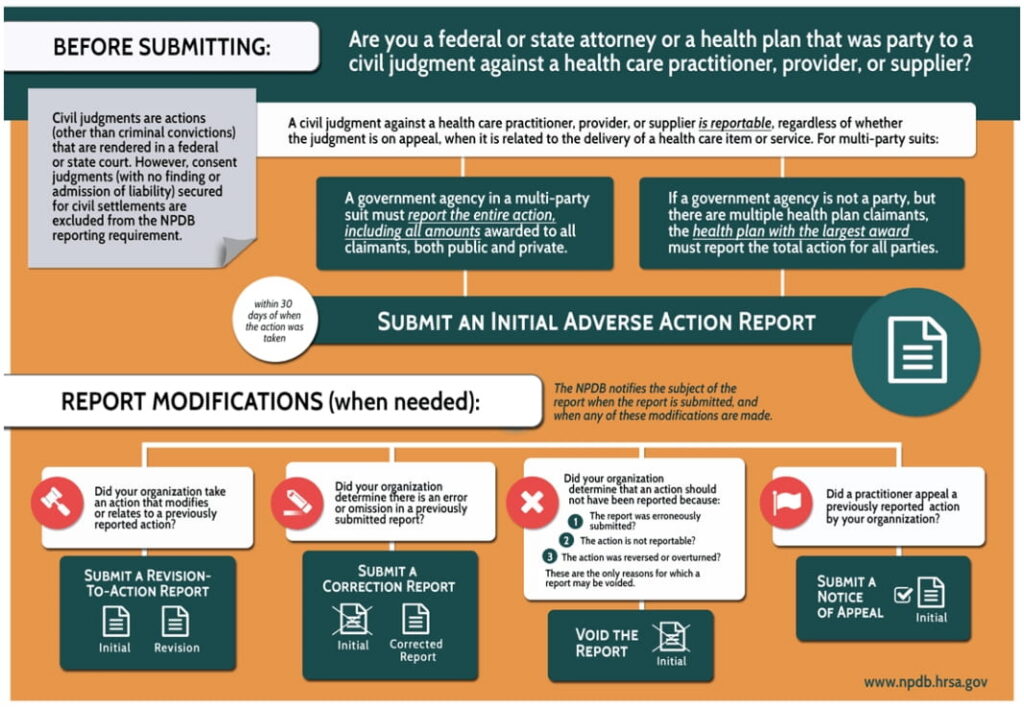
C. Health Care-Related Civil Judgments. Under Section 1128E of the Social Security Act, a "final adverse action" includes any civil judgment entered against a health care practitioner, supplier, or practitioner in federal or state court that is related to the delivery of a health care item or service.[24] The NPDB regulations define a civil judgment as "a court-ordered action rendered in a federal or state court proceeding, other than a criminal proceeding."[25] The reporting obligation falls on federal and state attorneys and health plans, and the report must be filed within 30 days of the entry of judgment, regardless of whether an appeal is pending.[26]
The practical scope of this category is broader than physicians and practitioners may realize. A judgment arising from a False Claims Act suit brought by the Department of Justice (DOJ) for fraudulent billing (for example, billing for services not rendered, upcoding, or medically unnecessary procedures) is reportable if a court enters judgment against the practitioner.[27] Other reportable civil judgments include:
- A judgment against a clinical laboratory for fraudulent billing and misleading marketing to health insurers;
- A judgment against a nursing home for patient neglect; and
- A judgment against an ambulance company for filing false claims for non-medically necessary transportation.[28]
The connecting thread is that the judgment must arise from conduct related to the payment, provision, or delivery of a health care item or service. A judgment against a health care practitioner arising from an automobile accident unrelated to patient care, or a fine imposed on a health care entity for employment discrimination, would not meet this standard and would not be reportable.[29]
Two important limitations narrow the scope of reportable actions under the False Claims Act. First, consent judgments entered solely to provide security for a civil settlement in which there was no finding or admission of liability are expressly excluded from reporting.[30] This distinction is significant in the context of a False Claims Act case. When a physician or practitioner settles a civil False Claims Act investigation by agreeing to pay a sum without admitting liability, that settlement payment is not reportable to the NPDB as a civil judgment, even if the settlement agreement is memorialized in a court order.[31] Second, civil judgments arising from medical malpractice claims are not reported under the civil judgment category at all. They are included under the separate medical malpractice payment reporting requirement, which applies whenever a payment is made on behalf of a practitioner in settlement or satisfaction of a malpractice claim, regardless of whether a court entered judgment.[32]
HRSA has assembled a chart to assess whether a health care-related civil settlement must be reported to the NPDB. This chart is provided below:
NPDB GUIDE TO REPORTING HEALTH CARE-RELATED CIVIL JUDGMENTS [33]
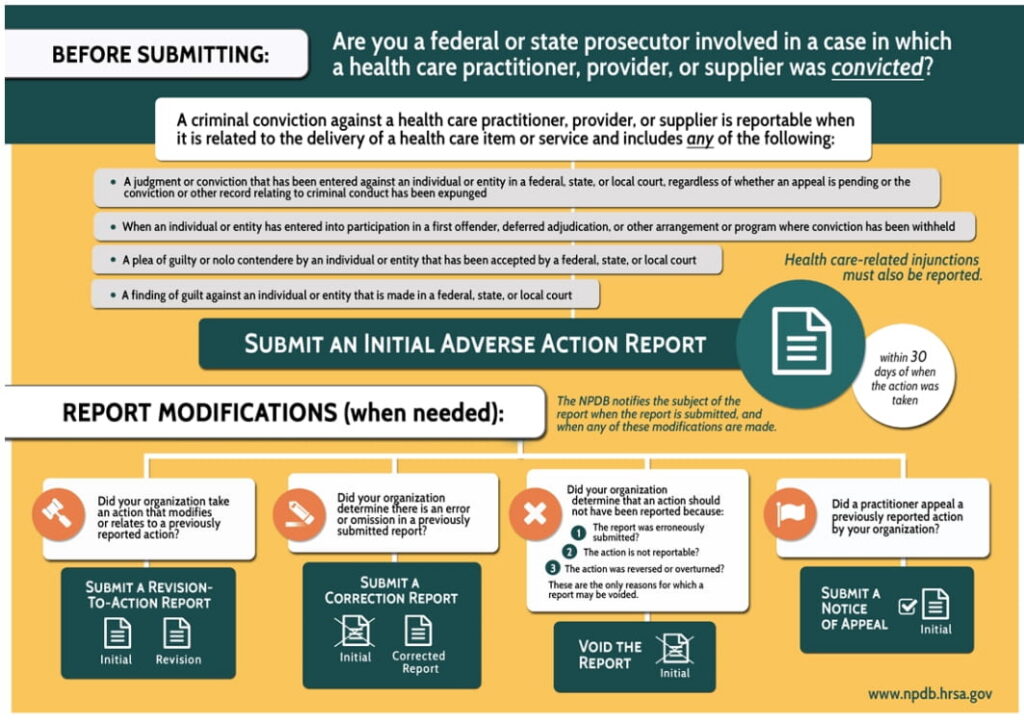
D. Health Care-Related Criminal Convictions. The category of health care-related criminal convictions reportable to the NPDB is both broad in scope and expansive in its definition of what constitutes a "conviction." This can catch a health care practitioner off guard. Under Section 1128E of the Social Security Act and its implementing regulations, federal and state prosecutors must report any criminal conviction of a health care practitioner, provider, or supplier related to the delivery of a health care item or service, regardless of whether the conviction is on appeal at the time of reporting.[34] The reporting obligation arises within 30 days of the conviction, not the sentencing.[35]
The reach of this category encompasses the full range of offenses arising in the context of health care fraud and abuse. Examples of reportable events under this category would include: [36]
- A physician convicted of health care fraud for billing Medicare or Medicaid for services not rendered;
- A chiropractor convicted of accepting kickbacks from a medical supply company in exchange for patient referrals;
- A nurse's aide convicted of abusing patients in a nursing home, a durable medical equipment company owner sentenced for conspiracy to submit false Medicare claims; and
- A hospital that pleads nolo contendere to illegally paying physicians for patient referrals.
Importantly, the criminal conduct must be linked to the delivery of, or payment for, a health care item or service. In contrast to the four examples cited above, health care practitioner criminal convictions that would not qualify as a reportable event include:[37]
- A registered nurse convicted of shoplifting;
- A dentist convicted of filing false claims under a homeowner's insurance policy; and
- A practitioner subject to an injunction for harassing a former spouse.
What makes this category particularly consequential for health care practitioners is the NPDB's deliberately expansive definition of "conviction." For NPDB purposes, a criminal conviction includes:
- A formal guilty verdict or a plea of guilty;
- A plea of nolo contendere (no contest);
- A finding of guilt by a court, and participation in a first offender program;
- Deferred adjudication; or
- Any other arrangement in which a conviction has been held in abeyance.[38]
A deferred adjudication agreement is one of the most misunderstood reporting provisions covered by the NPDB. A physician who accepts a deferred adjudication agreement, in which charges are held in abeyance, may move to have the charges dismissed if the defendant successfully completes probation. Unfortunately, a defendant physician may mistakenly believe that, because the practitioner avoided a conviction, no report to the NPDB will be made. The NPDB has confirmed that a physician who accepted a deferred conviction requiring a two-year probationary period in exchange for dismissal of a health care-related charge must still be reported, because participation in such a program qualifies as a conviction for NPDB purposes.[39]
It is also worth noting that the NPDB's definition of conviction expressly includes cases where a conviction or criminal record has been expunged.[40] Therefore, an NPDB report will remain on file permanently, regardless of the state court's subsequent expungement action.
Please keep in mind that a criminal conviction will not merely result in a report to the NPDB. A physician who pleads guilty to health care fraud will also be subject to mandatory exclusion from federal health care benefit programs by the OIG.[41] When a health care practitioner is excluded, the exclusion itself will result in a separate report to the NPDB. A single criminal case can therefore produce two distinct NPDB entries, one for the conviction and one for the resulting exclusion action taken by the OIG, each of which will be disclosed independently to every authorized entity that reviews the health care practitioner's NPDB record.
HRSA has assembled a chart to assess whether a health care-related criminal conviction must be reported to the NPDB. The chart is provided below:
NPDB GUIDE TO REPORTING HEALTH CARE-RELATED CRIMINAL CONVICTIONS[42]
E. Reporting Other Adjudicated Actions or Decisions. Of all the reportable categories in the NPDB framework, "other adjudicated actions or decisions" is the most difficult to define with precision. For that reason, it is also the most likely to catch health care practitioners off guard. It functions as a deliberate catch-all, designed to capture formal adverse actions that do not fit neatly into the more specific categories of malpractice payments, licensure actions, privilege revocations, criminal convictions, or civil judgments, but that nonetheless reflect on a practitioner's fitness to deliver health care services.[43]
The NPDB defines "other adjudicated action or decision" as a formal or official final action taken against a health care practitioner, provider, or supplier by a federal agency, state law enforcement agency, state Medicaid fraud control unit, state agency administering a state health care program, or health plan, that: (1) includes the availability of a due process mechanism; and (2) is based on acts or omissions that affect or could affect the payment, provision, or delivery of a health care item or service.[44] The due process requirement is the defining structural element of this category. The action need not follow a formal trial or hearing; it is sufficient that a due process mechanism was available to the health care practitioner, even if the practitioner chose not to use it.[45]
In practice, this category encompasses a wide range of scenarios that would be reportable as “other adjudicated actions or decisions.” For example, this category includes:
- A federal agency's reduction of a physician employee's pay for failure to appropriately supervise the delivery of health care services is reportable;[46]
- A federal hospital's termination of a nurse's employment following a formal investigation into patient abuse, where the nurse was afforded due process, is reportable;[47]
- A state hospital's suspension without pay of a physician who misrepresented his credentials on an employment application, after an investigation and formal hearing, is reportable;[48]
- A health plan's termination of a physician's contract for poor patient care, following due process procedures, is reportable;[49]
- A health plan's termination of a pharmacy's contract for improperly substituting generic compounds for prescribed brand-name drugs, after employing its established due process safeguards, is reportable;[50] and
- Finally, civil money penalties (CMPs) assessed by the OIG for improper Medicare billing, where the physician appealed and an administrative law judge upheld the penalty, are reportable as “other adjudicated actions or decisions.” CMPs are reportable to the NPDB because they are formal federal agency actions that include a due process mechanism and are based on conduct affecting the payment for health care services.[51]
While this category is quite broad, it does not cover various important actions. The following scenarios would not be reportable to the NPDB:
- Overpayment determinations and claim denial decisions made by federal or state health care payor programs, their contractors, or health plans are not reportable under this category, even when they result in a financial obligation for the practitioner;[52]
- The routine audit-and-repayment process (i.e., a Medicare contractor demanding repayment of alleged overpayments) is not reportable;
- Business or administrative contract terminations by health plans that are unrelated to health care fraud, abuse, or quality of care are not reportable. For instance, a health plan that terminates contracts with a group of psychologists simply because it has too many practitioners in a geographic area is not required to report those terminations, because the decision is administrative rather than being based on a practitioner’s conduct.[53]
- Non-medical settlements, where there are no findings or admissions of liability, are not reportable to the NPDB. For example, a physician who pays $30,000 CMPs to resolve an OIG investigation without admitting liability has not generated a reportable other adjudicated action. However, if the OIG matter results in the physician being excluded from participating in federal health benefit programs, the exclusion action would be separately reportable to the NPDB.[54]
The practical lesson for health care practitioners is that this category reaches well beyond final adjudicated civil judgments and criminal convictions. Actions taken by government employers, federal agencies, state program administrators, and health plans through their own internal administrative processes can result in NPDB reports, provided those processes afford due process and the underlying conduct relates to the delivery or payment of health care services. A physician who faces formal administrative proceedings, whether a federal pay reduction, a government hospital employment action, an OIG CMP proceeding, or a health plan contract termination for cause, is potentially facing an NPDB report, even if no court is ever involved.
HRSA has assembled a chart to assess whether an adjudicated action or decision must be reported to the NPDB. The chart is provided below:
NPDB GUIDE TO REPORTING OTHER ADJUDICATED ACTIONS OR DECISIONS [55]

F. Adverse Clinical Privileges Actions. Hospitals and other health care entities with formal peer review processes must report professional review actions that adversely affect a physician's or dentist's clinical privileges for more than 30 days. [56] This includes the voluntary surrender or restriction of clinical privileges while the practitioner is under investigation or to avoid an investigation.[57] Reports must be submitted to the NPDB and the appropriate state licensing board within 30 days of the date the action was taken.[58]
G. State Medical and Dental Board Licensure Actions. State medical and dental boards must report certain adverse licensure actions related to professional competence or conduct, including revocations, suspensions, reprimands, censures, and probations, to the NPDB.[59] State licensing and certification authorities must also report any dismissal or closure of proceedings by reason of the practitioner surrendering their license.[60]
H. Adverse Professional Society Membership Actions. Professional societies occupy a unique and often underappreciated role in the NPDB reporting framework. Under Title IV of the HCQIA, professional societies that conduct formal peer review are required to report adverse membership actions taken against physicians and dentists and may report such actions taken against other licensed health care practitioners.[61] The reporting obligation must be submitted to the NPDB within 30 days of the action.[62]
The threshold question for any professional society membership action is whether it was taken through a formal peer review process and was based on the member's professional competence or professional conduct that adversely affects, or could adversely affect, the health or welfare of a patient.[63] Both elements must be present. A professional society that takes an adverse membership action through an informal process or for reasons unrelated to patient care does not constitute a reportable event. The professional society itself makes the initial determination of whether the underlying conduct meets this standard, but that determination is subject to NPDB oversight.[64]
The range of reportable adverse actions is broad and includes any action that adversely affects a physician's or dentist's membership, such as denial, suspension, expulsion, termination, or probation, as long as the adverse action results from a formal peer review process.[65] Additionally, a professional society that denies membership to a physician after its peer-review committee finds that the physician failed to obtain the required informed consent for several patients must report that denial to the NPDB.[66]
I. Negative Findings by Accreditation Organizations. The reporting obligation for negative findings by private accreditation organizations is narrower in scope than that of other NPDB categories, but it carries significant practical consequences for health care facilities and suppliers. Under Section 1921 of the Social Security Act, private accreditation organizations are required to report certain negative actions or findings to the NPDB against health care entities, providers, and suppliers.[67] The key distinction from other reportable categories is that this obligation runs to entities, providers, and suppliers, not to individual practitioners. A physician's personal NPDB record is not directly affected by an accreditation finding against the hospital or facility where they practice, but the facility's NPDB record most certainly is, and that record is available to any eligible querying entity considering a business or contractual relationship with that facility.
J. Adverse DEA Controlled Substance Registration Actions. Every physician, dentist, podiatrist, veterinarian, nurse practitioner, physician assistant, and other licensed health care practitioner who prescribes or dispenses controlled substances must hold a valid DEA Certificate of Registration under the Controlled Substances Act of 1970.[68] That registration is not merely an administrative formality; it is a federal license to prescribe Schedule II through V controlled substances, and its loss or restriction is often a career-altering event. Under Title IV of the HCQIA and a memorandum of understanding between the DEA and HHS, the DEA is required to report adverse controlled substance registration actions against health care practitioners to the NPDB within 30 days of the action.
The DEA's request that a practitioner “voluntarily surrender” his or her DEA registration is a common administrative sanction sought by agency investigators. Unfortunately, the full ramifications of a physician voluntarily surrendering his or her DEA registration are often not fully understood by the health care practitioner. A 1997 OIG review found that the DEA was not reporting practitioners to the NPDB who voluntarily surrendered their registration numbers when confronted with a potential adverse action. This failure allowed hundreds of practitioners per year to escape NPDB disclosure by signing a voluntary surrender form rather than contesting the show-cause proceeding.[69] That deficiency has since been addressed, and current NPDB policy makes it clear that the surrender of a registrant’s DEA registration to avoid or resolve an investigation is reportable, regardless of whether the health care practitioner characterized it as voluntary.[70] A health care practitioner who receives a DEA “Order to Show Cause” and considers surrendering their registration in the hope that it will make the proceeding go away should understand that the surrender itself will generate an NPDB report, and that the report will remain on their permanent record even if the underlying investigation is never formally adjudicated. Prior to voluntarily surrendering your DEA registration, we strongly recommend that you first contact experienced health care regulatory counsel for advice.
K. Medicare and Medicaid Exclusions. Of all the adverse actions reportable to the NPDB, an exclusion from participation in Medicare, Medicaid, or other federal health care programs is among the most devastating. An exclusion is not merely an administrative sanction. An exclusion action effectively bars an individual from participating, directly, or indirectly, in federal health care programs.[71] For most physicians and health care practitioners, whose patient populations include substantial numbers of Medicare and Medicaid beneficiaries, an exclusion is effectively a prohibition on practice.
The OIG is the primary federal agency responsible for imposing exclusions and reporting them to the NPDB. Under Title IV of the HCQIA, the OIG reports monthly to the NPDB exclusions from participation in Medicare, Medicaid, and other federal health care programs, pursuant to a memorandum of understanding with HHS.[72] The same exclusions qualify as final adverse actions taken by a federal agency. Therefore, the exclusion action is separately reportable to the NPDB under Section 1128E of the Social Security Act.[73] State law enforcement agencies, state Medicaid fraud control units, and state agencies administering state health care programs are separately required to report exclusions from such programs.[74]
L. Penalties for Failure to Report. The NPDB imposes significant penalties on entities that fail to meet their reporting obligations. A malpractice payer that fails to report a medical malpractice payment is subject to a civil money penalty of up to $23,331 per payment.[75] A hospital or health care entity that fails substantially to report adverse actions will have its name published in the Federal Register and will lose its immunity from liability under Title IV for a period of three years.[76] Health plans that fail to report required adverse actions face civil money penalties of up to $39,811 per adverse action.[77]
III. What Is Not Reportable to the NPDB?
Health care practitioners should also understand what actions do not meet the strict criteria for NPDB reporting. Hospitals, employers, and peer review bodies sometimes threaten to report actions that are not legally reportable, either through ignorance of the law or as a form of institutional leverage. Health care legal experts have identified the following as generally non-reportable events:
A. Employment Termination Actions. If an employment termination action is not the result of a professional review action, even though the termination action automatically resulted in the revocation of a health care practitioner’s clinical privileges, such an action is not reportable to the NPDB.[78]
B. Administrative Privilege Suspensions. From a technical standpoint, administrative suspensions of a physician’s privileges are not reportable to the NPDB. Examples of administrative suspension actions would include:
- Failure to pay staff dues;
- Failure to attend staff meetings; or
- Failure to complete medical records on a timely basis.
Unfortunately, the distinction between an administrative privilege suspension and professional review actions is not always clear in practice, and hospitals do not always draw the line correctly. A hospital that routes a medical records delinquency notice through its peer review committee and frames the resulting suspension as a professional conduct matter has potentially converted a non-reportable administrative privilege suspension action into a reportable one, even though the underlying conduct (incomplete records) is the same.[79]
C. Contract Terminations. The automatic termination of a physician's clinical privileges due to the end of a contract or employment arrangement is not reportable. Likewise, if a physician's medical group loses its exclusive services contract with a hospital, the resulting loss of privileges should not be reported to the NPDB.[80]
D. Being Investigated. A complaint or an investigation into a practitioner's competence or conduct is not reportable unless the practitioner surrenders privileges to avoid the investigation, fails to renew privileges while under investigation, or resigns to avoid the investigation. This distinction is critically important. A practitioner who resigns or surrenders privileges during an investigation may inadvertently trigger a mandatory NPDB report.[81]
E. Military Nonjudicial Punishment. At the outset, it is important to note that this issue is murky, but these actions are likely not reportable to the NPDB. However, the Supreme Court has described Article 15 as “an administrative method of dealing with the most minor offenses,” and the Court and numerous federal circuits have held that nonjudicial punishment is not a criminal prosecution.[82] Therefore, it does not meet the NDPB’s definition of a criminal conviction and is not reportable to the data bank under that category. Additionally, because a nonjudicial punishment action is not rendered in a court proceeding, it does not qualify as a reportable civil judgment under the NDPB's definition. Administrative disciplinary proceedings under Article 15 of the Uniform Code of Military Justice (UCMJ) are not criminal convictions, do not constitute a civil judgment, and should not be reported to the NPDB.
F. Misc. Administrative Deficiencies. As set out in the NPDB Guidebook’s Q&A section, the following deficiencies would not be reportable to the data bank:
- Failure to maintain minimum professional liability coverage;
- Failure to be board certified.
- Failure to live within the geographic proximity of the hospital; and
- Failure to perform a minimum number of procedures required by the organization to qualify for a particular clinical privilege.[83]
IV. Is Reporting to the NPDB Ever Discretionary?
Surprisingly, there are certain adverse actions for which a reporting entity is authorized and encouraged to submit a report to the NPDB, but it is not legally required to do so. In our experience, negotiations with reporting entities in cases involving these actions have been the most fruitful. The types of adverse actions and/or health care practitioners for which reporting is permissive, not mandatory, are discussed below.
A. Adverse Clinical Privilege Actions Against Non-Physician and Non-Dentist Health Care Practitioners.
Under Title IV, hospitals and other health care entities with formal peer review are required to report adverse clinical privilege actions against physicians and dentists. However, reporting is optional for all other licensed health care practitioners, including nurse practitioners, physician assistants, nurses, pharmacists, psychologists, physical therapists, and other allied health professionals. Please note that medical malpractice payors are required to report adverse actions taken against any health care practitioner, not merely those involving physicians and dentists.[84]
V. The Effect of a Possible NPDB Report on the Litigation and Settlement Process:
One consequence of an NPDB report is that it can distort the medical malpractice litigation process. Since hospitals and credentialing bodies are required by law to query the NPDB when evaluating a physician for privileges (and every two years thereafter), an NPDB report is effectively a permanent stain on a practitioner's record.[85]
A. The Malpractice Insurer-Physician Conflict. In the context of the NPDB, a significant conflict of interest may arise between physicians and their malpractice liability insurers. In a medical malpractice case brought against a physician, the defendant physician, fearing the career-ending implications of an NPDB report, may refuse a settlement and demand that the insurer litigate the claim to judgment, even when settlement would be the most rational economic outcome. Unfortunately, the malpractice carrier may strongly believe that the case should be settled. Physicians should carefully check their malpractice insurance policies. Malpractice policies often include provisions that grant the insurance company the exclusive contractual right to settle claims.
The case of Webb v. Witt illustrates this conflict. In this case, a defendant physician resisted her insurer's decision to settle a malpractice claim on her behalf, arguing that the settlement would prevent her from entering insurer networks and obtaining hospital privileges, and that reporting the settlement to the NPDB would prevent her from securing future medical liability insurance. The court rejected her claims and allowed the insurer to settle on behalf of the hospital and physicians.[86]
B. The "Blacklist" Effect. As one commenter has noted, the NPDB's influence on litigation behavior is profound: "The fear of an NPDB entry from malpractice litigation or settlement is driving physicians to press their insurers to mount a complete defense and litigate claims to judgment." [87] This dynamic can prolong litigation, delay compensation for injured patients, and impose enormous costs on the health care system, all without any corresponding improvement in the accuracy of the information reported to the NDPB.
V. The Consequences of an NPDB Report:
When an entry is made in the Data Bank, it triggers a cascade of professional and financial repercussions for the health care practitioner. The consequences of an NPDB report are not merely theoretical; they are immediate, concrete, and often permanent.
- Loss of Hospital Privileges and Credentialing. Hospitals rely heavily on NPDB reports when making credentialing decisions. A negative report can lead to the denial of new privileges, the revocation of existing privileges, or the imposition of burdensome monitoring requirements. Because hospitals are legally required to query the NPDB before granting privileges and every two years thereafter, an NPDB report will surface at every subsequent credentialing cycle for the remainder of the practitioner's career.
- State Medical Board Actions. When a state medical board becomes aware of an NPDB report, it may initiate its own independent investigation, potentially leading to further disciplinary action, practice restrictions, or the suspension or revocation of the physician's medical license. In states with reciprocity agreements, similar restrictions may also be pursued by other state licensing boards.
- Malpractice Insurance Consequences. Malpractice insurers use NPDB data to assess underwriting risk. A report can result in significantly increased insurance premiums, the denial of coverage, or the non-renewal of an existing policy, making it difficult or impossible for the practitioner to maintain the insurance required to practice.
- Exclusion from Payer Networks. Medicare, Medicaid, and private payor insurance companies may terminate a physician’s enrollment or deny a physician’s reenrollment application based on the contents of an NPDB report, effectively crippling the physician’s ability to generate revenue and serve patients.
- Specialty Society Consequences. A professional specialty society may suspend or revoke a physician's membership or board certification if the physician has had a restriction or conditional provision placed on their practice. This can then trigger additional employment consequences.
VI. How to Challenge an Inaccurate NPDB Report:
If a health care practitioner believes an NPDB report is factually inaccurate or was submitted in violation of NPDB reporting requirements, they have the right to dispute the entry. However, the dispute process is highly restrictive, heavily favors the reporting entity, and has been widely criticized for inadequately protecting the rights of health care practitioners.
A. Administrative Challenges to an Inaccurate NPDB Report. The process for challenging an NPDB report is governed by 42 U.S.C. § 11136, 45 C.F.R. § 60.21, and Chapter F of the NPDB Guidebook. It involves up to six sequential steps, with an optional seventh step for reconsideration. The process is formal, document-intensive, and subject to strict jurisdictional limitations. Experienced legal counsel should be engaged before initiating any step. An overview of each step is discussed below:
Step 1: Conduct a Self-Query to Review Your NDPB Record. Before challenging an NDPB report, a health care practitioner must first review the information that has been submitted by a reporting entity. Health care practitioners can perform an online self-query of their records and request that a copy of the report be mailed to them.
Step 2: Submit a Subject Statement. After reviewing the information currently contained in the NPDB, a health care practitioner (referred to as the “subject” of the NPDB report) may choose to submit a statement into the report. This statement can be submitted to the NPDB at any time, including before, during, or after initiating the formal dispute process. A statement submitted by the subject can be a narrative of up to 4,000 characters. This statement is permanently attached to the report and is disclosed to all future queriers alongside the report itself.[88] This statement is the health care practitioner’s opportunity to provide context, correct misleading characterizations, and present their perspective on the information reported. Importantly, the statement submitted by the subject does not require the reporting entity to make any changes to the previously submitted report or to trigger any review by the NPDB. It is, however, one of the most important tools available to a health care practitioner to tell their side of the story. We strongly recommend that health care practitioners obtain assistance from health care regulatory legal counsel when submitting this statement. It can meaningfully impact how credentialing bodies interpret an adverse report.
Step 3: Entering the Report into Dispute Status. To formally initiate a challenge to a report, a health care practitioner must enter the report into “Dispute Status” by logging into the NPDB portal and indicating disagreement with either:
- The factual accuracy of the report; or
- Whether the report was submitted in accordance with NPDB reporting requirements, including the eligibility of the reporting entity to file the report.[89]
Placing an NPDB report in Dispute Status will have two immediate consequences. First, the NPDB will notify the reporting entity that the report is disputed. Second, the NPDB will notify all queriers who received the report within the past three years that the report has been disputed by the subject. Moreover, this dispute notation will be included with the report when it is disclosed to future queriers.[90] Placing an NPDB report in Dispute Status does not trigger an NPDB review. It is the first procedural step in challenging a submission's accuracy, not the final one.[91]
Step 4: Attempting Direct Resolution with the Reporting Entity. After placing an NPDN report in Dispute Status, a health care practitioner must wait at least 60 days. During this time, the health care practitioner must make documented efforts to contact the reporting entity and seek correction or voiding of the report.[92] If the reporting entity provides written notice that it refuses to correct or void the report before 60 days have elapsed, the health care practitioner may immediately request elevation to the formal Dispute Resolution level without waiting the full 60-day period. The practitioner should contact the NPDB Customer Service Center and provide documentation of the reporting entity's refusal.[93]
Step 5: Requesting Formal Dispute Resolution.[94] If the 60-day period has elapsed without satisfactory resolution (or if the reporting entity has refused in writing), the health care practitioner may request that the report be elevated to formal Dispute Resolution. At this level, the Division of Practitioner Data Bank (DPDB) of the Health Resources and Services Administration has been delegated authority by the Secretary, HHS, to review the dispute.[95]
Step 6: Await the Decision on the Dispute. The DPDB will review the documentation submitted by the health care practitioner and the reporting entity. Rulings that the DPDB can make include:
- Rule that the Report is Accurate as Submitted. In this case, a decision letter setting out this ruling is sent to the health care practitioner, the reporting entity, and all queriers who received the dispute notification and the report within the past three years.
- Rule that the Report is Inaccurate as Submitted. In the event of this ruling, the reporting entity will be asked to void the report. If the reporting entity fails to void the report, the DPDB may do so.
- Rule that the Report Does Not Meet the NPDB’s Reporting Requirements. If the DPDB issues this ruling, the reporting entity will be asked to void the report. If it agrees, the report is removed from the health care practitioner’s record and all queriers who received it within the past three years are advised to destroy the report and any copies. If the reporting entity refuses to void the report, the DPDB may do so.
As a final point in this regard, if the issues raised are outside the DPDB's jurisdiction, the dispute notation will be removed from the report, and a decision letter will be issued.
Step 7: Request for Reconsideration of the DPDB Ruling. After the DPDB issues its ruling, if a health care practitioner remains dissatisfied with the decision, the practitioner can submit a written request for reconsideration to the DPDB. Importantly, this is the final administrative appeal remedy available to a practitioner.
B. Appeal Rights After Exhausting the Administrative NPDB Dispute Resolution Process. Once administrative remedies have been exhausted, a health care practitioner who remains dissatisfied with an NPDB report has a limited set of further options. Post-Dispute Resolution options are narrow, legally complex, and have been disfavored by courts. The NPDB's internal dispute process is designed to be the final administrative word on the accuracy and reportability of a report, and federal courts have been highly deferential to the agency's determinations. Courts have consistently upheld the NPDB's position that it is merely an informational repository and that its jurisdiction does not extend to adjudicating the merits of underlying disputes.[96] While judicial remedies are quite limited, several avenues remain available to a practitioner who has exhausted the internal process and remains dissatisfied. Each carries significant limitations that must be understood before pursuing it.
Option #1: File for Federal Court Review. After exhausting the NPDB's internal administrative process, a health care practitioner may seek judicial review in federal district court under the Administrative Procedure Act (APA).[97] The APA authorizes federal courts to review final agency actions and to set aside agency decisions that are "arbitrary, capricious, an abuse of discretion, or otherwise not in accordance with law."[98]The Eleventh Circuit Court of Appeals confirmed this avenue in Leal v. Secretary, U.S. Department of Health and Human Services.[99] In Leal, the complainant filed an APA action in federal district court after the DPDB upheld an NPDB report about a 60-day clinical privileges suspension. The court confirmed that APA review of the DPDB’s Dispute Resolution decision is available but applied the highly deferential arbitrary and capricious standard of review. Under this standard of review, the court's role is only to ensure that the agency "came to a rational conclusion," not to conduct its own independent investigation or substitute its judgment for that of the agency.[100]
Option #2: File a Federal Court Action under the Privacy Act. A second judicial avenue is an action under the Privacy Act of 1974,[101] which requires federal agencies to maintain accurate, complete, timely, and relevant records about individuals and to make reasonable efforts to ensure accuracy before disseminating those records to third parties.[102]
In Doe v. Thompson,[103] the U.S. District Court for the District of Columbia held that a physician could challenge an inaccurate NPDB Adverse Action Report under the Privacy Act, because the Act requires HHS to "make reasonable efforts to assure that such records are accurate, complete, timely, and relevant for agency purposes" before disseminating them. The court confirmed that the Privacy Act provides a viable legal theory for challenging NPDB reports where the internal administrative process has been exhausted.[104] Please note that Doe v. Thompson also illustrates the most significant practical limitation of proceeding under the Privacy Act. There is a two-year statute of limitations that effectively bars most cases from seeking relief under this legal argument. In Doe v. Thompson, the physician's Privacy Act claims were dismissed as time-barred because more than two years had elapsed between the dissemination of the inaccurate report and the filing of the lawsuit.[105] The Privacy Act's limitations period runs from the date the practitioner knew or had reason to know of the alleged inaccuracy. In the case of an NPDB report, the two-year period typically starts to run on the date the report was first disclosed or the date the practitioner received notice of it.
Option #3: File a Lawsuit Against the Reporting Entity. As a final “Hail Mary,” a health care practitioner may consider suing the reporting entity directly. Independent of any challenge to the NPDB itself, a lawsuit against the reporting hospital, insurer, or other organization for filing a false or incorrect report may bring the reporting entity to the negotiation table. Unfortunately, lawsuits against a reporting entity must overcome a significant roadblock – HCQIA. A reporting entity that files a report with the NPDB in the reasonable belief that the action was warranted is immune from civil liability for that report. This immunity covers the reporting entity, its members, staff, and authorized agents. [106] To overcome this presumption of immunity, a health care practitioner must show that the reporting entity did not act in the reasonable belief that the action was in furtherance of quality health care, that it did not make a reasonable effort to obtain the facts, or that it acted with actual knowledge of the falsity of the information reported.[107]
VII. Frequently Asked Questions (FAQ):
The Frequently Asked Questions (FAQ) section below is designed to address the practical concerns most commonly raised by physicians and other health care practitioners when they first encounter the NPDB, whether in the context of a False Claims Act case, a malpractice claim, a hospital credentialing review, a peer review investigation, a Medicare exclusion action, or a licensing board inquiry.
- What is the purpose of the NPDB? The NPDB was designed to solve the "wandering physician" problem. This occurs when an incompetent or dangerous practitioner who, upon facing discipline or adverse action in one state, could simply relocate and resume practice elsewhere without any disclosure of their prior record. By creating a national clearinghouse, Congress sought to close this gap and ensure that credentialing bodies nationwide had access to a practitioner's full history of malpractice payments and adverse actions before granting privileges or employment. Simply put, the primary goals of the NPDB are to improve health care quality, protect the public, and reduce health care fraud and abuse in the United States.[108]
- Can the public — including my patients — search for my name in the NPDB? No. The NPDB is a confidential information clearinghouse. Reports are not available to the public or to patients. Access is restricted to eligible entities defined by statute, including hospitals, state licensing boards, health plans, peer review organizations, and the practitioners themselves.[109] This confidentiality is a fundamental feature of the system, though it does not diminish the professional consequences of an entry.
- How long does a report stay in the NPDB? Reports remain in the NPDB permanently unless they are successfully disputed and voided through the formal Dispute Resolution process. There is no statute of limitations on a report's presence in the Data Bank, and no mechanism for automatic expungement after a period of years. A single report filed at the beginning of a physician's career will be disclosed at every credentialing inquiry for the remainder of that career.[110]
- If I settle a malpractice claim but do not admit liability, will it still be reported to the NPDB? Yes. The law requires that any payment made on behalf of a practitioner for medical malpractice be reported, regardless of whether liability is admitted. The NPDB statute explicitly provides that a payment made in settlement of a claim "shall not be construed as creating a presumption that medical malpractice has occurred," but the payment must nonetheless be reported.[111] This is one of the most consequential and controversial aspects of the NPDB system.[112]
- My hospital suspended my privileges for 14 days while they investigated a complaint. Is this reportable? Generally, no. Adverse clinical privileges actions must affect the practitioner's privileges for more than 30 days to be reportable to the NPDB. A suspension of 30 days or fewer does not meet the statutory threshold. However, if the practitioner voluntarily surrenders or restricts their privileges during the investigation, even temporarily, that action may itself be reportable. You should consult with a health care attorney before taking any action in response to a hospital investigation.[113]
- My insurer wants to settle a malpractice case against my wishes. Can I stop them? This depends on the terms of your malpractice insurance policy and your state's law. Malpractice policies often grant the insurer the exclusive right to settle claims within policy limits without the physician's consent. Some states require insurers to offer "Consent to Settle" policy options, while others permit insurers to settle over a physician's objection. If your insurer settles a matter over a health care practitioner’s objection, the resulting payment will be reported to the NPDB, along with the health care practitioner’s name. You should immediately contact your medical malpractice carrier if you know of facts that may lead to a malpractice claim.
- Can I sue the NPDB or the reporting entity if they refuse to remove an inaccurate report? Yes. However, please keep in mind that litigation against the NPDB itself is extremely difficult. Courts have consistently upheld the NPDB's position that it is merely an informational repository and lacks authority to adjudicate the underlying merits of a dispute. Suits against reporting entities for filing inaccurate reports have also largely failed, as courts have been reluctant to impose liability for reports that accurately reflect the entity's written record, even if that record is incomplete or misleading. This underscores the importance of preventing an inaccurate report from being filed in the first place.
- Should I pay a malpractice settlement out of my own pocket to avoid an NPDB report? This is a complex legal strategy that carries significant risks and should never be attempted without the guidance of an experienced health care regulatory attorney. In 1993, the U.S. Court of Appeals for the District of Columbia held that:
“. . . an NPDB regulation requiring a report from each "person or entity" making a medical malpractice payment was invalid when applied to payments made by a practitioner on his or her own behalf, because the regulation was inconsistent with statutory language requiring any "entity" to report medical malpractice payments to the NPDB.”[114]
- What is the difference between a "Subject Statement" and a "Dispute"? A Subject Statement is a narrative of up to 4,000 characters that a practitioner can add to their NPDB report at any time. It is attached to the report and disclosed to all future queriers, but it does not require the reporting entity to make any changes or trigger any review by the NPDB.[115] A Dispute, by contrast, is a formal challenge to the factual accuracy or reportability of the report. Entering Dispute Status notifies the reporting entity and past queriers of the challenge and is the first step toward requesting formal Dispute Resolution by the Secretary of HHS.[116]
- Does the NPDB report the amount of a malpractice settlement? Yes. NPDB reports include the total amount of the malpractice payment, a description of the settlement or judgment terms, and a narrative description of the acts or omissions and injuries upon which the action was based. [117] The payment amount is disclosed to all eligible entities that request the report. In the case of confidential settlements, the NPDB Guidebook notes the following:
“Confidential terms of a settlement or judgment do not excuse an entity from the statutory requirement to report a payment to the NPDB or from providing a narrative describing the payment. The reporting entity should explain in the narrative section of the [Medical Malpractice Payment Report] MMPR that the settlement or court order stipulates that the terms of the settlement are confidential.”[118]
- Are nurse practitioners, physician assistants, and other non-physician practitioners reported to the NPDB? They can be. However, the reporting of health care practitioners other than physicians or dentists is permissive rather than mandatory. While the original HCQIA focused primarily on physicians and dentists, subsequent legislation, particularly Section 1921 of the Social Security Act, expanded the NPDB's scope to cover all licensed health care practitioners, including nurse practitioners, physician assistants, pharmacists, psychologists, and other licensed practitioners.[119] Malpractice payments made on behalf of any health care practitioner are reportable, and adverse licensure actions by state boards against any licensed practitioner must also be reported.
- Are NPDB reports limited to only health care practitioners? No. The NPDB is also designed to collect information on adverse actions taken against health care entities, providers, and suppliers. As discussed in the NPDB Guidebook, depending on the facts, a reporting entity may choose to report bookkeepers, accountants, business managers, and others who have committed a reportable act.[120]
- What should I do if I receive a notice that I am about to be reported to the NPDB? You should contact an experienced health care regulatory attorney immediately. Some organizations provide advance notice to a health care practitioner of the organization’s intent to file a report with the NPDB. This notice period is a critical window of opportunity to challenge the proposed report and negotiate with the reporting entity. Do not ignore a notice of an intent to report, and do not take any action (such as resigning or surrendering privileges) without first consulting with an experienced health care attorney.
- How does the NPDB interact with state medical board investigations? When a malpractice payment is made, the reporting entity must submit the report to both the NPDB and the appropriate state licensing board simultaneously. Conversely, when a state medical board takes an adverse action against a practitioner, it must report that action to the NPDB. This creates a feedback loop in which an NPDB report can trigger a state board investigation, and a state board action can generate a further NPDB report, compounding the consequences of a single adverse event.
VIII. Strategies for Protecting Yourself from Adverse NPDB Reporting:
Unfortunately, by the time a physician is notified that a report has been filed with the NPDB, a practitioner’s options to avoid the potential negative consequences of a report may have already passed. In Webb v. Witt, the court held that an insurer may settle a malpractice claim despite a physician's strong objection.[121] Finally, the case Doe v. Thompson demonstrated that even a physician who was fully exonerated may be unable to obtain an expungement of references to an inaccurate NPDB report.[122]
The following strategies, drawn from the legal landscape described throughout this article, represent some, but not all, of the proactive measures a physician can take.
Strategy Tip #1: Negotiate a "Consent to Settle" Clause Before Purchasing Malpractice Insurance. Selecting the right malpractice insurance is one of the most important decisions a physician makes regarding NPDB exposure. As Feliberty v. Damon and Webb v. Witt both illustrate, the standard language of most malpractice policies grants the insurer the exclusive contractual right to settle claims within policy limits without the physician's consent. Once that policy is in force and a claim is filed, the physician's ability to prevent an NPDB-triggering settlement is severely constrained. A "Consent to Settle" clause requires the insurer to obtain the physician's written consent before settling any claim on their behalf.
Before purchasing or renewing any malpractice policy, a physician should retain experienced health care legal counsel to review the policy language and negotiate the most protective terms available. The time to address this issue is at the contracting stage, not after a claim has been filed and the insurer is already at the settlement table.
Strategy Tip #2: Understand Your Policy's Reporting Obligations and Consent Requirements. Even physicians who believe they have a "Consent to Settle" clause should not assume that protection is absolute. As Aquilina v. O'Connor demonstrated, courts have interpreted the scope of such clauses narrowly, finding that a negotiated dismissal of a suit does not necessarily constitute a "settlement" requiring the physician's consent.[123] The practical implication is that insurers and their retained defense counsel may structure resolutions in ways that technically circumvent a consent-to-settle clause, leaving the physician without recourse. A physician should work with a qualified health care attorney to understand precisely what their malpractice insurance policy covers, what actions require their consent, and under what circumstances the insurer-retained defense counsel is (and is not) authorized to act on their behalf. This review should occur at the time of policy purchase, at each renewal, and at the earliest stage of any malpractice claim.
Strategy Tip #3: Engage Independent Legal Counsel at the First Sign of a Malpractice Claim. The attorney retained by a malpractice insurer to defend a physician has a primary obligation to the insurer, not to the physician. While defense counsel is generally required to act in the physician's best interests, the inherent conflict of interest between an insurer seeking to minimize its financial exposure and a physician seeking to protect their professional reputation is well-documented in the case law.[124] When a malpractice claim is filed or even threatened, a physician should consider bringing in independent legal counsel, separate from the insurer-appointed defense attorney, to advise them on their own interests. Independent counsel can review the policy terms, advise on the physician's rights regarding settlement decisions, monitor the conduct of the insurer-retained defense attorney, and intervene if the insurer appears to be moving toward a settlement that would result in an NPDB report that would be against the physician's interests.
Strategy Tip #4: Respond Strategically to Peer Review Investigations — and Never Resign Under Pressure Without Discussing Such an Action with Your Attorney. The case law and NPDB regulations make it clear that one of the most dangerous traps for a physician facing a peer-review investigation is the voluntary surrender of their privileges or agreeing to a restriction of clinical privileges. Under 42 U.S.C. § 11133, the voluntary surrender of privileges while under investigation, or to avoid an investigation, is itself a mandatory reportable event. A physician who resigns from a medical staff or surrenders privileges in the face of an investigation, even with the intention of avoiding conflict, may inadvertently trigger the very NPDB report they were trying to prevent. Before taking any action in response to a peer review investigation, a physician must consult with an experienced health care attorney. The distinction between a voluntary resignation unrelated to any investigation and a resignation that constitutes a surrender of privileges to avoid an investigation is a legal determination that requires careful analysis of the specific facts and timing. A physician who acts without legal guidance in this situation risks converting a non-reportable event into a mandatory NPDB report.
Strategy Tip #5: Responding to a Proposed Multi-Defendant Settlement. Physicians who routinely practice in high-acuity settings, such as emergency departments, intensive care units, and operating rooms, should be especially vigilant about the terms of any group settlement and should insist on separate legal representation whenever a multi-defendant malpractice claim is filed.
Strategy Tip #6: Conduct Periodic Self-Queries of the NPDB. Health care practitioners are authorized to query the NPDB for information reported about themselves at any time. A self-query is a straightforward and inexpensive process that allows a physician to review their own NPDB record and identify any reports they may not have been properly notified of. While the NPDB is required to notify a practitioner when a report is filed, notification failures occur, and a physician unaware of an existing report cannot take steps to dispute or respond to it. A periodic self-query, conducted annually or before any credentialing application, is a simple but powerful tool for maintaining awareness of one's NPDB record. If a report is identified that the physician contends is inaccurate or non-reportable, the 60-day clock for initiating the dispute process can be started immediately, rather than being discovered for the first time during a credentialing review.
Strategy Tip #7: Document Everything During Peer Review and Disciplinary Proceedings. The NPDB's Dispute Resolution process is limited to determining whether a report accurately reflects the reporting entity's written record. The NPDB will:
- Not conduct an independent medical investigation;
- Not examine the merits of the underlying clinical dispute; and
- Not consider evidence outside the reporting entity's documentation.
The quality and completeness of the written record created during a peer review or disciplinary proceeding can be critical to your case. A physician who is the subject of a peer review investigation should work with legal counsel to ensure that their perspective, evidence, and responses are fully and accurately documented in the written record at every stage of the proceeding. This documentation serves two purposes: it establishes the evidentiary foundation for a future NPDB dispute if an adverse report is filed, and it may persuade the peer review body to resolve the matter without requiring a report.
Strategy Tip #8: Act Immediately Upon Receiving a Notice of Intent to Report. Reporting entities may provide a health care practitioner with advance notice before filing an NPDB report. This notice period, however brief, represents a critical window of opportunity that should not be wasted. Upon receiving a notice of intent to report, a physician should immediately retain experienced health care legal counsel to assess whether the proposed report meets the legal criteria for NPDB reporting, to communicate with the reporting entity about the accuracy and reportability of the proposed report, and to explore all available options for preventing the report from being filed. As the cases discussed throughout this article demonstrate, the ability to challenge or correct a report diminishes dramatically once it has been filed with the NPDB and disclosed to querying entities. The time to act is before the report is submitted to the NPDB, not after.
Ultimately, it has been our observation that the physicians who obtain the most favorable results when responding to an NPDB report are those who have taken deliberate steps, with the guidance of experienced health care legal counsel, to understand the system, manage their contractual relationships, and protect their professional record before a crisis arises.
IX. Responding to an NPDB Report:
When a health care practitioner faces the potential or actual filing of an NPDB report, the stakes could not be higher. Navigating the complex regulatory framework, avoiding unwarranted reports, and challenging inaccurate entries requires specialized legal expertise. The most effective way to manage an NPDB report is to prevent it from being filed in the first place.
You should consult with experienced health care regulatory counsel at the earliest sign of trouble, when a hospital, employer, or insurer signals an intent to take an action that could result in a report to the Data Bank. Your attorney can analyze whether a threatened action actually meets the legal criteria for NPDB reporting, negotiate with reporting entities to structure settlements or disciplinary resolutions in ways that do not trigger reporting requirements, and advise physicians on the critical distinction between resigning voluntarily and surrendering privileges under investigation.
Should you need to navigate through the full NPDB dispute process, experienced legal counsel can collaborate with you to compile the necessary documentation, identify procedural defects in the reporting entity's submission, and relentlessly pursue the correction or voiding of unauthorized or inaccurate entries.
Are you dealing with a potential NPDB report or a report that has already been filed with the Data Bank? Give us a call for a free consultation to discuss whether we can assist you. We can be reached at (202) 298-8750 or 1 (800) 475-1906.
Liles Parker PLLC is a national health care law firm founded by a former federal prosecutor and the former General Counsel of a Fortune 500 company and is uniquely equipped to defend health care professionals against these career-threatening actions. Liles Parker is not a typical law firm. Our team includes former federal prosecutors, several of whom held significant positions at the U.S. Department of Justice, former HHS legal counsel, and experienced health care regulatory attorneys who hold certifications as Certified Professional Coders (CPC), Certified Medical Compliance Officers (CMCO), and Certified Medical Reimbursement Specialists (CMRS). The firm has been rated "AV" by Martindale-Hubbell — an honor described as "limited to only the most distinguished law practices," for over 20 years.

Robert and the other attorneys at Liles Parker represent health care practitioners, providers, and suppliers around the country in a full range of Medicare, Medicaid, and private payor audits and investigations. If you are dealing with NPDB issues, schedule a free initial consultation with Liles Parker.
- [1] U.S. Dep't of Health & Human Servs., Health Res. & Servs. Admin., NPDB Guidebook A-1 [hereinafter NPDB Guidebook].
https://www.npdb.hrsa.gov/guidebook/ABackground.jsp. - [2] George Maliha, The Distortive Effect of the National Practitioner Data Bank on Medical Malpractice Litigation and Settlement, 56 Harv. J. on Legis. 287, 288 (2019), https://journals.law.harvard.edu/jol/wp-content/uploads/sites/86/2019/05/HLL106_crop.pdf.
- [3] Health Care Quality Improvement Act of 1986 (HCQIA), Pub. L. No. 99-660, tit. IV, 100 Stat. 3743, 3784 (codified at 42 U.S.C. §§ 11101–11152).
- [4] 42 U.S.C. § 11101(1)-(2).
- [5] NPDB Guidebook, supra note 1, at A-2; see also Maliha, supra note 2, at 287.
- [6] NPDB Guidebook, supra note 1, at A-2.
- [7] Reporting to the National Practitioner Data Bank, 88 Fed. Reg. 19, 581 (April 3, 2023).
- [8] Maliha, supra note 2, at 287.
- [9] NPDB Guidebook, supra note 1, at A-2; also see History, Nat'l Practitioner Data Bank.
https://www.npdb.hrsa.gov/topNavigation/timeline.jsp. - [10] Id.
- [11] NPDB Guidebook, supra note 1, at A-2.
- [12] Health Insurance Portability and Accountability Act of 1996, Pub. L. No. 104-191, § 221(a), 110 Stat. 1936, 2010 (codified at 42 U.S.C. § 1320a-7e); also see NPDB Guidebook, supra note 1, at A-2.
- [13] Patient Protection and Affordable Care Act, Pub. L. No. 111-148, § 6403, 124 Stat. 119, 764 (2010); NPDB Guidebook, supra note 1, at A-3.
- [14] Maliha, supra note 2, at 288.
- [15] Maliha, supra note 2, at 295; NPDB Guidebook, supra note 1, at E-11.
- [16] HHS, HRSA Health Workforce, NPDB Insights
https://www.npdb.hrsa.gov/enews/Mar2025Insights.jsp. - [17] 42 U.S.C. § 11131(a). Also see What You Must Report to the NPDB, Nat'l Practitioner Data Bank, [hereinafter What You Must Report].
https://www.npdb.hrsa.gov/hcorg/whatYouMustReportToTheDataBank.jsp. - [18] 42 U.S.C. § 11131(b); see also NPDB Guidebook, supra note 1, at E-11.
- [19] NPDB Guidebook, supra note 1, at E-11.
- [20] 42 U.S.C. § 11137(d).
- [21] Bono MJ, Wermuth HR, Hipskind JE. Medical Malpractice. StatPearls Publishing. https://www.ncbi.nlm.nih.gov/books/NBK470573/.
- [22] Based on data compiled by Thomson Reuters for the years 2019 through 2024.
https://calculatemycase.com/medical-malpractice/average-medical-malpractice-settlement - [23] Donald Illich, What Federal Practitioners Need to Know About the National Practitioner Data Bank, 39 Fed. Pract. 82, 82–83 (2022). https://pmc.ncbi.nlm.nih.gov/articles/PMC9014936/.
- [24] 42 U.S.C. § 1320a-7e(g)(1)(A)(i)
- [25] 45 C.F.R. § 60.3, defining "civil judgment."
https://www.npdb.hrsa.gov/guidebook/ECivilJudgements.jsp - [26] 45 C.F.R. § 60.3; see also NPDB Guidebook, supra note 1, at E-105, Table E-24.
- [27] NPDB Guidebook, supra note 1, at E-104, Table E-23.
- [28] NPDB Guidebook, supra note 1, at E-105, Table E-24.
- [29] Id.
- [30] NPDB Guidebook, supra note 1, at E-105, Table E-24; see also 42 U.S.C. § 1320a-7e(a).
- [31] NPDB Guidebook, supra note 1, at E-105.
- [32] NPDB Guidebook, supra note 1, at E-3, Table E-1.
See also 42 U.S.C. § 11131(a) (Title IV malpractice payment reporting requirement). - [33] HHS Infographic, “NPDB Guide to Reporting Health Care-Related Civil Judgments.”
https://www.npdb.hrsa.gov/hcorg/reportingCivilJudgments.jsp - [34] 42 U.S.C. § 1320a-7e(g)(1)(A)(ii)
- [35] NPDB Guidebook, supra note 1, at E-97.
- [36] Id., at E-101, Table E-22.
- [37] Id.
- [38] Id. at E-97.
- [39] Id. at E-100, Table E-22.
- [40] Id. at E-97.
- [41] 42 U.S.C. § 1320a-7. For additional information on OIG exclusions, see our article titled “OIG Exclusion Actions – Mandatory and Permissive Exclusion Authorities.”
- [42] HHS Infographic, “NPDB Guide to Reporting Health Care Related Criminal Convictions.”
https://www.npdb.hrsa.gov/hcorg/reportingCriminalConvictions.jsp - [43] NPDB Guidebook, supra note 1, at E-107.
- [44] 45 C.F.R. § 60.3. (defining "other adjudicated actions or decisions").
- [45] NPDB Guidebook, supra note 1, at E-108.
- [46] Id., at E-110, Table E-26.
- [47] Id., at E-112.
- [48] Id., at E-114.
- [49] Id., at E-113.
- [50] Id., at E-114.
- [51] Id., at E-115.
- [52] Id., at E-110, Table E-26.
- [53] Id., at E-109.
- [54] Id., at E-114; see also E-119, Table E-19.
- [55] HHS Infographic, “NPDB Guide to Reporting Other Adjudicated Actions or Decisions.”
https://www.npdb.hrsa.gov/hcorg/reportingOtherAdjudicatedActions.jsp - [56] NPDB Guidebook, supra note 1, at E-31.
- [57] Id., at E-69 through E-70.
- [58] Id., at E-5, Table E-2.
- [59] Id.
- [60] Id.
- [61] Id., at E-59, Table E-7.
- [62] Id., at E-60.
- [63] Id., at E-59.
- [64] Id.
- [65] Id.
- [66] Id., at E-60, Table E-8.
- [67] Id., at E-91 & E-92, Table E-17.
- [68] 21 U.S.C. § 822(a) (2024) (requiring all practitioners who dispense, administer, or prescribe controlled substances to register with the DEA); Administrative Actions, DEA Diversion Control Division. https://www.deadiversion.usdoj.gov/administrative_actions.html
- [69] OIG report titled “Drug Enforcement Administration Reporting to the National Practitioner Data Bank.” OEI-12-96-00160 (March 1997).
- [70] NPDB Guidebook, supra note 1, at E-86.
- [71] Exclusion Statute, OIG, U.S. Dep't of Health & Human Servs. 42 U.S.C. § 1320a-7.
https://oig.hhs.gov/compliance/physician-education/fraud-abuse-laws/ - [72] The OIG reports exclusion actions to the NPDB monthly.
https://www.npdb.hrsa.gov/hcorg/whatYouMustReportToTheDataBank.jsp - [73] 42 U.S.C. § 1320a-7e(g)(1)(A)(iv).
- [74] Exclusions, supra note B, Table E-19.
- [75] Id. (citing civil money penalty of up to $23,331 per payment).
- [76] Id.
- [77] Id. (citing civil money penalty of up to $39,811 per adverse action for health plans).
- [78] HRSA Health Workforce, NPDB Insights. https://www.npdb.hrsa.gov/enews/Apr2017Insights.jsp#:~:text=No.%20The%20termination%20was%20not,of%20the%20practitioner's%20clinical%20privileges.
- [79] NPDB Guidebook, supra note 1, at E-48.
- [80] Id., at E-34.
- [81] Id., at E-36.
- [82] Middendorf v. Henry, 425 U.S. 25, 31–32 (1976).
- [83] Id., at E-35.
- [84] HHS, NPDB, “Can Health Centers Report or Query on Health Care Practitioners Who are Not Physicians or Dentists?” https://www.npdb.hrsa.gov/qa/hc3.jsp
- [85] 42 U.S.C. § 1135(a)(1) and (2).
- [86] Webb v. Witt, 876 A.2d 858, 862–63 (N.J. Super. App. Div. 2005).
- [87] Maliha, supra note 2, at 288.
- [88] Id., at F-2.
- [89] Id., at F-3.
- [90] Id.
- [91] Id.
- [92] Id., F-4.
- [93] Id.
- [94] The NPDB's jurisdiction in Dispute Resolution is strictly and narrowly limited by federal regulation. The DPDB will only determine: (1) Whether the report was submitted in accordance with NPDB reporting requirements, including the eligibility of the reporting entity; and (2) Whether the report accurately depicts the action taken as reflected in the reporting entity's written record. It is important to keep in mind that the DPDB will not review the underlying merits of the case. It will not consider whether medical malpractice occurred, whether a diagnosis was correct, whether the practitioner was afforded proper due process, or whether the action was justified. The DPDB explicitly states that it "has no legal authority to provide an independent medical investigation concerning clinical issues specified in the report, nor can it examine the validity of information provided in the report."
- [95] Id., at F-5.
- [96] In Doe v. Thompson, 332 F. Supp. 2d 124 (D.D.C. 2004), a physician struggled for two years to correct a report about a temporary suspension from which he had been completely cleared, ultimately being barred by the statute of limitations under the Privacy Act.
- [97] 5 U.S.C. §§ 701–706.
- [98] 5 U.S.C. § 706(2)(A).
- [99] Leal v. Secretary, U.S. Department of Health and Human Services, 620 F.3d 1280 (11th Cir. 2010).
- [100] Leal, at 1283–1284.
- [101] 5 U.S.C. § 552a.
- [102] 5 U.S.C. § 552a(e)(6).
- [103] Doe v. Thompson, 332 F. Supp. 2d 124, 126 (D.D.C. 2004).
- [104] Id. at 129–33.
- [105] Id. at 134.
- [106] 42 U.S.C. § 11111.
- [107] 42 U.S.C. § 11111(a)(1).
- [108] HHS, NPDB, “What is the National Practitioner Data Bank (NPDB)?” https://www.npdb.hrsa.gov/faqs/d3.jsp
- [109] About Us, Nat'l Practitioner Data Bank. https://www.npdb.hrsa.gov/topNavigation/aboutUs.jsp
- [110] HHS, NPDB “When do reports expire in the NPDB? https://www.npdb.hrsa.gov/faqs/d7.jsp
- [111] 45 C.F.R. § 60.7(d).
- [112] 42 U.S. Code § 11131(a).
- [113] NPDB Guidebook, supra note 1, at E-31.
- [114] HHS, NPDB, “Payments by Individuals.” Also see American Dental Association v. Shalala, 303 U.S. App. D.C. 231 (August 27, 1993). https://www.npdb.hrsa.gov/guidebook/EMMPR.jsp; https://openjurist.org/3/f3d/445/american-dental-association-v-e-shalala
- [115] NPDB Guidebook, supra note 1, at E-11.
- [116] Id, at F-3.
- [117] Id., at E-16.
- [118] Id. at E-21.
- [119] Id. at C-9.
- [120] Id. at C-10.
- [121] Webb v. Witt, 876 A.2d 858 (July 8, 2005).
- [122] Doe v. Thompson,332 F. Supp. 2d at 124-127.
- [123] See Maliha, supra note 89, at 291–93.
- [124] Id.