
(August 3, 2026): Pain has become a place where medicine, law, and patient needs collide. Chronic pain is not a marginal public-health issue. In its most recent survey, the Centers for Disease Control and Prevention (CDC) estimated that 60 million adults, nearly 1 in 4, in the United States suffer from chronic pain. More than 21 million adults live with “high-impact chronic pain” that substantially restricts daily activities.[1] Yet many of those patients now experience the health-care system not as a place of relief, but as a checkpoint system: monthly visits, dosage ceilings, urine tests, pill counts, pharmacy refusals, insurance denials, and the recurring insinuation that a person seeking pain relief is seeking drugs rather than care. The result is what many patients and clinicians describe as the Criminalization of Pain, a system in which opioid prescribing is so closely associated with law-enforcement risk that legitimate patient needs are ignored, delayed, or denied.
I. The Basics – The Business of Prescribing Controlled Substances Can Be a Murky Proposal:
Under Drug Enforcement Administration (DEA) regulations, a controlled-substance prescription is valid only if issued for a “legitimate medical purpose” by a practitioner acting in the “usual course” of professional practice. Importantly, both the prescriber and the pharmacist bear responsibility for improper prescribing or dispensing. That standard is meant to distinguish appropriate medical care from patient abuse and possible diversion. But because pain is subjective, chronic pain is heterogeneous, and patients suffering from significant pain often feel that their needs are effectively secondary to the government’s regulatory enforcement concerns. Unfortunately, the line between reasonable, effective opioid treatment and excessive prescribing practices has been difficult for federal prosecutors to draw. Our concern is that physicians, nurse practitioners, and physician assistants focused on the care and treatment of chronic pain patients have modified their controlled-substance prescribing practices to avoid the intense scrutiny and second-guessing by government investigators and prosecutors.
II. Overview of the Government’s Controlled Substances Enforcement Efforts:
To its credit, the Department of Justice (DOJ) has a long history of investigating and prosecuting individuals and entities involved in the illegal diversion of controlled substances and the trafficking of illegal drugs. As recently as last month, the DOJ announced that 36 defendants, including 28 licensed medical professionals, were charged in connection with the alleged illegal diversion of prescription opioids and other controlled substances that resulted in patient harm. Two examples of recent cases brought by the DOJ are discussed below:
- Pennsylvania. In the Eastern District of Pennsylvania, three defendants were charged with conspiracy to unlawfully distribute controlled substances. The defendants allegedly operated a voicemail refill line that allowed patients to request and receive refills of Schedule II controlled substance prescriptions. The government has alleged that some patients who used the refill line to obtain Schedule II controlled substances from the defendants suffered drug overdoses and died. The government further contends that the defendants continued to operate the refill line to prescribe Schedule II controlled substances without interacting with patients. [2]
- Texas. In the Southern District of Texas, a pharmacist and two clinic managers were indicted for drug conspiracy related to the distribution of controlled substances at two pill mills in Houston and a pill mill pharmacy in Conroe, Texas. The government alleges that more than 3.4 million pills of opioids and other controlled substances were improperly prescribed to patients brought to the clinics and pharmacy by street-level drug traffickers for further distribution. [3]
In individual pain-clinic cases, DEA press releases often allege that prescriptions were issued “for no legitimate medical purpose and outside the usual course of professional practice,” a phrase that mirrors the regulatory standard and may result in long prison sentences and the forfeiture of assets seized from the defendants.
In the case of Ruan v. United States, the U.S. Supreme Court held that to convict a physician of unlawful distribution of controlled substances under the Controlled Substances Act (CSA), the government must prove beyond a reasonable doubt that, after the physician produces evidence that prescribing was authorized, the physician knowingly or intentionally acted in an unauthorized manner. The Court expressly noted that the regulatory language governing authorized prescribing is “ambiguous” and “open to varying constructions,” and that a strong scienter requirement is needed to reduce the risk of overdeterrence.[4]
Unfortunately, the diversion of opioids and other controlled substances isn’t the only challenge law enforcement faces. There is robust, multi-source evidence that illicitly manufactured fentanyl and ever-changing synthetic fentanyl analogs have infiltrated our country’s drug supply and are frequently sold as heroin or pressed into counterfeit prescription pills. As discussed later in this article, pain physicians' efforts to adequately test for and prevent fentanyl abuse have been ignored, and in some instances penalized, by CMS and law enforcement.
III. The Adverse Impact of Excessive Deterrence:

We all agree that unlawful pill mills cannot be ignored. For many years, our country has faced a catastrophic overdose crisis, with prescription opioids playing a significant role, followed by waves of illicitly manufactured fentanyl. Federal and state law enforcement agencies have a legitimate duty to prevent diversion, prosecute fraud, and discipline clinicians who knowingly sell prescriptions. But the same enforcement strategy that can close a pill mill can also frighten conscientious physicians into abandoning patients with complex, high-dose, or simply inconvenient cases. The central problem is not enforcement itself. The problem is that the fear of enforcement has effectively isolated a segment of chronic pain patients and made it difficult, if not impossible, for them to obtain pain relief. The risk of excessive deterrence is not hyperbole. DOJ and DEA enforcement initiatives have repeatedly framed opioid prescribing as a criminal threat, not merely a clinical-quality or licensing issue. Issues facing pain practitioners and their patients include:
- The Current Enforcement Environment Has a Chilling Effect on Prescribers. A qualitative study of opioid prescribers in West Virginia captured this chilling effect with unusual clarity. The researchers interviewed twenty opioid-prescribing primary-care physicians and specialists and identified four themes: fear of disciplinary action, intensified fear from restrictive legislation, care shifts and treatment gaps, and conversion to illicit substances. The study reported that disciplinary actions against opioid prescribers produced fear that contributed to forced tapering and opioid under-prescribing, and that some clinicians believed accepting patients who legitimately needed opioids could jeopardize their careers. One physician described this fear bluntly: “the fear of having your license taken away or the fear of imprisonment, or you’ve been burned by the DEA as someone who has been negligent, that will take over.” Another described pharmacists reporting physicians to the DEA and said that “the DEA would come and destroy you.” [5]
- Artificial Barriers Are Being Erected by Wary Physicians. Pain practitioners, acting defensively in response to fear of intense regulatory scrutiny, have institutionalized compliance rituals that function as access tolls rather than individualized clinical safeguards. Mandatory monthly visits, urine drug screening with punitive consequences for unexpected results, morphine-milligram-equivalent ceilings applied without clinical justification, blanket refusals to accept inherited opioid patients, and pain-management agreements modeled on probation conditions are frequently used not to improve patient outcomes but to generate a paper trail demonstrating regulatory conformity. These barriers fall disproportionately on the patients least able to navigate them: those with disabilities, poverty, rural residence, or inadequate transportation. These are the very populations that CDC data shows have the highest prevalence of chronic and high-impact chronic pain.
- Pharmacists Are Creating Their Own Barriers to Patient Pain Relief. The pharmacy counter has become another enforcement frontier. DEA’s regulations impose a “corresponding responsibility” on pharmacists who fill controlled-substance prescriptions.[6] As a result, a properly issued prescription from a physician for a controlled substance is not always sufficient. DEA production quotas add a separate supply constraint. In the 2025 aggregate-production-quota proceeding, DEA received 1,882 comments from registrants, chronic pain patients, pain-advocacy groups, doctors, nurses, and others raising concerns about opioid shortages, difficulty filling authorized prescriptions, increased overdose deaths despite declining quotas, and interference with medical expertise. Commenters reported that local pharmacies were often out of stock, forcing patients to contact additional pharmacies, travel farther, and sometimes fail to fill prescriptions.[7] In the 2026 quota proceeding, DEA received 5,044 comments, including similar concerns about perceived opioid shortages, patient difficulty filling authorized prescriptions, pharmacy ordering thresholds, and clinicians being impeded from exercising medical judgment.[8]
- Ultimately, Patients Pay the Price for Excessive Deterrence. The impact of an unwarranted prosecution does not stop with the targeted physician. When a pain clinic closes, its patients do not disappear. They spill into primary-care offices, emergency departments, and specialty queues, often while physically dependent on long-term therapy. The New England Journal of Medicine reported the abrupt May 2021 closure of a 29-clinic pain-management practice in California, leaving approximately 20,000 patients without pain management services. Long-term opioid patients received thirty days of medication and instructions to find another clinician.[9] Many of these patients then discovered that primary-care clinicians were unwilling to prescribe opioids, that few new clinicians would prescribe opioids to new patients, and that referrals to pain specialists could take as long as six months. The authors concluded that it had become “hard to find a clinician who will prescribe opioids for chronic pain—and nearly impossible” for a long-term opioid patient seeking a new clinician.[10]
IV. The CDC Acknowledges That Excessive Enforcement Can Hurt Patients:
Federal health agencies have repeatedly warned that rigid opioid reduction can harm patients. In 2019, the CDC stated that policies attributed to the 2016 guideline had gone beyond its recommendations and could put patients at risk. The CDC specifically rejected hard limits, such as cutting off opioids above 90 Morphine Milligram Equivalents (MME), and abrupt tapering or sudden discontinuation.[11] The Department of Health and Human Services (HHS) has likewise warned that opioids should not be tapered rapidly or discontinued suddenly because physically dependent patients may suffer withdrawal, pain exacerbation, serious psychological distress, and suicidal thoughts, and may seek illicit opioids to treat pain or withdrawal.[12] The 2022 CDC guideline reiterated that recommendations should not be applied as inflexible standards, should not replace individualized clinical judgment, and should not be implemented as absolute limits by governments, health systems, or payers.[13] The CDC also acknowledged that misapplication of earlier guidance contributed to untreated and undertreated pain, withdrawal, worsening pain outcomes, psychological distress, overdose, and suicidal ideation or behavior.[14] Unfortunately, these admonitions have largely fallen on deaf ears in enforcement.
V. Risk Areas Faced by Pain Physicians and Practices:
In a perfect world, law enforcement would be able to readily distinguish between criminal prescribing practices and the proper treatment of patients with chronic pain. Prosecutors would reserve prosecution for cases involving unlawful diversion and drug dealing while making it clear that an individualized opioid treatment regimen, including high-dose or long-term opioid treatment (when clinically justified), is not illegal. Law enforcement should treat documentation as evidence of a prescriber’s medical reasoning, not as a trap for technical noncompliance. Finally, the government should discourage the abandonment of pain patients, require transition plans when pain clinics close, and ensure that pharmacies do not overreach.
Pain physicians and pain management practices are likely to remain under law enforcement’s scrutiny for the foreseeable future. Therefore, it is imperative that they review their operational practices, medical-necessity assessments, coding, billing, and prescribing practices. The regulatory risk areas faced by pain physicians and practices are outlined below:
A. Interventional Pain Procedure Risks. Interventional pain procedures are a primary driver of practice revenue and a major focus of audits by the Department of Health and Human Services, the Office of Inspector General (OIG), and CMS program integrity contractors. Regulators frequently target procedures performed without adequate conservative therapy or beyond established frequency limits. Specific procedures regularly audited by CMS program integrity contractors and the OIG include:
-
Epidural Steroid Injections (ESIs). Epidural steroid injections are among the most common interventional procedures performed by pain management physicians, yet they are also among the most heavily scrutinized areas of Medicare Part B billing. Because of their high volume and the potential for overuse, the OIG and CMS Medicare Administrative Contractors (MACs) have implemented strict coverage limitations and aggressive audit programs to recover improper payments. The OIG has repeatedly targeted spinal pain management procedures, dedicating an entire series of Work Plan projects to auditing Medicare payments for facet joint injections, epidural steroid injections, and the anesthesia administered during these procedures.[15]In March 2023, the OIG published a comprehensive audit report detailing improper Medicare payments for epidural steroid injection sessions. The OIG found that Medicare improperly paid $3.6 million for 80,419 sessions that exceeded the strict coverage limitations set forth in the applicable Local Coverage Determinations (LCDs).[16] The OIG concluded that neither CMS nor the MACs had adequate oversight mechanisms to prevent or detect payments for sessions exceeding the allowed frequency limits. Consequently, the OIG recommended that CMS direct the MACs to recover the $3.6 million in improper payments and notify the physicians involved so they could exercise reasonable diligence to identify, report, and return any overpayments under the 60-day rule.[17]The OIG's scrutiny extends beyond the injections themselves to the ancillary services billed alongside them. In July 2025, the OIG released a report examining Medicare payments for anesthesia administered during spinal pain management procedures, including ESIs. CMS guidelines state that moderate or deep sedation, general anesthesia, or monitored anesthesia care (MAC) is usually unnecessary for these procedures and is rarely indicated, except in exceptional cases that must be clearly documented. However, the OIG audit found that Medicare Part B paid physicians $45.7 million for anesthesia administered during selected spinal pain management procedures that were at risk for noncompliance. The OIG estimated that if CMS oversight had prevented these at-risk payments, Medicare could have saved $17.7 million over a 28-month period, as medical records frequently failed to document the rare circumstances required to justify the anesthesia.[18]For pain management practices, these audits underscore a critical compliance reality. High-volume interventional procedures, such as epidural steroid injections, are actively monitored by CMS program integrity contractors and the OIG using data analytics. Pain practices and physicians that routinely exceed rolling 12-month frequency limits, bypass conservative therapy prerequisites, or routinely bill for concurrent anesthesia without highly individualized documentation may face significant regulatory exposure and financial liability.
-
Facet Joint Injections. Facet joint injections, including diagnostic medial branch blocks, intraarticular injections, and radiofrequency ablations, are critical tools for managing chronic axial spinal pain. However, their high utilization and prior history of medically unnecessary billing have made them an ongoing target for the OIG and CMS program integrity contractors.As with epidural steroid injections, facet joint injections and radiofrequency ablations are subject to strict LCD frequency limits (e.g., a maximum number of diagnostic or therapeutic sessions per region per year). A critical risk area is performing a radiofrequency ablation without a documented, successful diagnostic block (e.g., failing to document the required percentage of pain relief from the block before proceeding to ablation). Radiofrequency ablation involves the thermal destruction of the facet joint medial branch nerves. These procedures are considered medically reasonable and necessary only if the patient has first undergone at least two diagnostic medial branch blocks. Each diagnostic block must provide at least 80 percent sustained relief of the primary (index) pain. Performing a radiofrequency ablation without documenting this 80 percent relief from the dual diagnostic blocks is a direct violation of the LCD and renders the radiofrequency ablation claim subject to denial and recoupment. Furthermore, repeat radiofrequency ablation procedures at the same anatomic site are limited to a maximum of two sessions per rolling 12-month period and require documentation of at least 50 percent improvement in pain for at least six months following the initial radiofrequency ablation procedure.[19]The OIG has aggressively audited facet joint injections, repeatedly finding that Medicare has paid millions of dollars for procedures that violated strict LCD requirements. In a comprehensive audit published in March 2023, the OIG reviewed Medicare Part B payments for spinal facet-joint injections and found that Medicare improperly paid physicians for injections that did not comply with Medicare requirements and guidance. It is also worth noting that fraudulent facet joint billing has been the focus of a criminal prosecution in Texas.[20]
-
Spinal Cord Stimulation. Spinal cord stimulation procedures are an advanced, high-cost interventional therapy for chronic intractable pain. Because these procedures can involve significant surgical risk and substantial Medicare reimbursement, CMS has imposed strict documentation requirements. One component of spinal cord stimulation pain management compliance risk is the failure to properly separate and authorize the trial phase from the permanent implant or proceeding to permanent implantation without documenting the required therapeutic success during the trial phase. [21]Because of the high cost of these procedures, CMS has designated spinal cord neurostimulation as an approved complex review topic for Recovery Audit Contractors (RACs). Medical records are routinely reviewed after payment to confirm that the two-stage process was followed and that the required pain relief was achieved and documented before the permanent system was surgically implanted.[22]In recent years, the OIG has identified systemic improper billing practices involving neurostimulator devices. The term “neurostimulator” refers to a general category of implantable devices that includes spinal cord, deep brain, and vagus nerve stimulator devices. [23] Providers performing spinal cord stimulation procedures must ensure that all medical necessity, documentation, coding, and billing requirements have been met.
-
Trigger Point Injections. Trigger point injections are commonly used in pain management to treat myofascial pain syndrome, but they are highly susceptible to coding errors, overutilization, and subsequent regulatory enforcement. CMS program integrity contractors, the OIG, and the DOJ have increasingly targeted claims for trigger point injections, focusing on improper billing practices and a lack of medical necessity.Risks include billing per muscle rather than per session (e.g., CPT® Code 20552 is designated for injections of one or two muscles, while CPT® Code 20553 is designated for injections of three or more muscles).[24] Providers must ensure that the codes billed are based on the number of muscle groups injected per session, not the number of individual needle insertions.In the event of an audit, law enforcement and government contractors will review the medical record to determine whether the documentation shows that the administered injections were medically necessary. CMS requires that the documentation clearly identify the evaluation process used to diagnose the trigger point, including a history of the onset of pain, a palpable taut band of muscle, focal tenderness, and reproduction of the referred pain pattern.[25]
B. Billing, Coding, and Documentation Compliance. Accurate coding and documentation are the foundation of compliance. The same documentation that supports clinical care is required to justify reimbursement.
-
Upcoding E/M Levels. Upcoding occurs when a health care provider bills for a more complex set of services than is justified by medical decision-making or the time spent in the patient's care. For pain management practices, routinely billing high-level established patient visits (e.g., CPT® Code 99214 or CPT® Code 99215) without adequate supporting documentation is a major compliance risk that can trigger audits by the OIG and CMS program integrity contractors. In egregious cases, it may also lead to possible liability under the civil False Claims Act.CMS program integrity contractors are experienced in reviewing data analytics to compare a pain management physician's E/M billing distribution with that of peers in other pain specialties. If a pain management physician's billing profile heavily skews toward CPT® Codes 99214 and 99215, they are highly likely to face targeted prepayment probes or post-payment medical reviews. If the subsequent review reveals that the medical decision-making or documented time only supported an E/M service at the 99213 level, the pain management physician and his practice may be liable for repayment of an overpayment and may face possible False Claims Act liability.
-
Modifier 25 Misuse. For pain management practices, appending Modifier 25 to an Evaluation and Management (E/M) service on the same day as a minor surgical procedure (such as an epidural steroid injection, a facet joint injection, or a trigger point injection) is a highly scrutinized billing practice. It is important to keep in mind that the Medicare global surgical package already includes both preoperative and postoperative care associated with a minor procedure.Both the OIG [26] and CMS program integrity contractors have repeatedly raised concerns with health care providers about the inappropriate use of Modifier 25. Claims appended with Modifier 25 are currently being audited, and the government is actively recovering improper payments for overlapping services. To properly bill for an E/M service, the service must be significant, separately identifiable, and supported by documentation beyond the standard pre-procedure assessment.
-
Improper Billing of “Incident-To” Services. Many pain practices currently employ nurse practitioners (NPs) and physician assistants (PAs). Medicare has identified several basic prerequisites that must be met for the services of a qualified physician extender (such as NPs and PAs) to be billed incident-to the professional services of a supervising physician. As set out below, Medicare Part B pays for services and supplies incident-to the services of a physician (or another qualified practitioner). The billing requirements for incident-to are discussed below:
- Who qualifies as “auxiliary personnel”? In the context of a pain management practice, the primary auxiliary personnel supervised and billed under the incident-to rules are NPs and PAs. They qualify to be billed incident-to, regardless of whether the individual is an employee, a leased employee, or an independent contractor of the physician or of the same entity that employs or contracts with the physician.[27]
- State licensure is required. To bill Medicare, both the supervising physician and the mid-level practitioner whose services are to be billed incident to must be properly licensed by the state.[28]
- State scope of practice limitations. For the services of an NP or PA to qualify for coverage and payment, the specific service at issue must fall within the mid-level practitioner’s scope of practice.[29]
- Collaborative agreement requirements. Many states require that NPs work under an appropriate collaborative practice agreement with a physician.[30]
- Services covered. With respect to NPs, Medicare Part B covers the services they perform only if those services would be covered if furnished by a physician, are not otherwise statutorily excluded from coverage, AND the mid-level practitioner performs the services while working in “collaboration” with a physician. There is considerable controversy over the extent of independent practice that PAs may exercise. We recommend that you regularly monitor your state’s collaborative practice requirements for both NPs and PAs, as these requirements may change. Please note that even in states that require a collaborative agreement, the physician responsible for collaborating with a mid-level practitioner need not be the practitioner’s “supervising physician” for incident-to billing purposes.
- Credentialing. The supervising physician must be credentialed by Medicare. As long as the supervising physician is licensed and properly credentialed with Medicare, services performed by qualified NPs and PAs incident-to the professional services of the physician may be billed under the physician’s NPI, even though the mid-level practitioner may not be credentialed with Medicare.
- Non-institutional setting. While there are a few exceptions to the general rule, CMS defines an “Institutional Setting” as “all settings other than a hospital or skilled nursing facility.”
- Integral, although incidental, part of the physician’s professional service. Over the years, there has been a fair amount of discussion regarding this requirement. Essentially, CMS takes the position that the services provided incident-to those of the supervising physician must be an incidental part of the direct, professional services furnished by the physician to initiate a course of treatment.[31] One question that frequently arises is “How often does a physician need to see a patient?" As set out in the Medicare Benefit Policy Manual, “there must be subsequent services by the physician of a frequency that reflects the physician’s continuing active participation in and management of the course of treatment.”[32]
- Commonly included in the physician’s bills. This requirement is self-explanatory. If a service would normally be billed by a physician’s office, it is likely to qualify for incident-to billing.[33]
- Services are of a type that are commonly furnished in physicians’ offices or clinics. Where supplies are clearly of a type a physician is not expected to have on hand in his/her office, or where services are of a type not considered medically appropriate to provide in the office setting, they would not be covered under the incident-to provision. Outpatient services that are provided in offices and clinics may still be billed under Medicare’s “incident-to” provisions if Medicare’s restrictive billing guidelines are met.[34]
- “Direct” supervision is required. The physician (or other practitioner) supervising the auxiliary personnel need not be the same physician who is treating the patient more broadly. However, only the supervising physician (or other practitioner) may bill Medicare for incident-to services. Under recently revised regulations, “The presence of the physician (or other practitioner) required for direct supervision may include virtual presence through audio/video real-time communications technology (excluding audio-only) for services without a 010 or 090 global surgery indicator.” [35], [36]
- Must be subsequent to the initial encounter. Incident-to services cannot be rendered on the patient’s first visit or if a change to the plan of care (e.g., medication adjustment) is required.[37]
- New or worsened patient complaint. If the visit involves a new or worsened complaint, a physician must conduct an initial E/M for that complaint and must establish the diagnosis and plan of care.[38]
Liles Parker attorneys are regularly asked to speak at conferences and provider meetings on incident-to issues. Unfortunately, this issue has been a recurring problem for pain management practices for many years. Although incident-to billing has been around (in one form or another) since 1977, physicians and their billing staff still have problems billing incident-to services correctly.[39] We strongly recommend that pain management practices billing the services of NPs and PAs incident-to the supervision of a credentialed physician, engage experienced health care counsel to review these services.
C. Urine Drug Testing Risks. Urine drug testing is essential for responsible opioid management, but it is also one of the largest sources of False Claims Act enforcement and overpayment demands in pain management.
-
Blanket Orders for Urine Drug Testing. For pain management practices, using standing orders for definitive urine drug testing is among the most dangerous actions a practice or ordering physician can take. A standing order that automatically triggers comprehensive, definitive urine drug testing for every patient at every visit, without an individualized clinical assessment at the time of ordering, directly violates Medicare's coverage requirements. Both the DOJ and OIG have aggressively pursued cases against pain practices, laboratories, and ordering physicians that used protocol-driven, non-individualized urine drug testing protocols. The enforcement record is extensive. Ordering urine drug testing in this fashion can expose both your practice AND the ordering physician (in his individual capacity) to massive civil damages and penalties under the False Claims Act. In egregious cases, federal prosecutors have charged individuals and entities with criminal violations for this conduct. The regulatory framework is unambiguous: definitive urine drug testing must be ordered on an individualized, patient-specific basis, and routine or blanket standing orders are expressly prohibited.
-
Presumptive vs. Definitive Testing. Federal prosecutors, the OIG,[40] and CMS program integrity contractors have repeatedly audited and penalized pain management practices that order expensive definitive (laboratory-based, quantitative) urine drug testing without first conducting lower-cost presumptive (point-of-care or immunoassay) testing and considering those results. The government argues that this improper practice bypasses the clinically and regulatorily required two-step testing sequence, generates medically unnecessary costs, and has cost the Medicare and Medicaid programs millions of dollars.While we recognize that, at first glance, the government’s arguments make sense, regulators have failed to account for the inherent weaknesses of presumptive testing. Arguably, the emergence of illicitly manufactured fentanyl analogs and synthetic opioids in the United States has made it medically necessary to order both presumptive and definitive urine drug testing when monitoring patients with pain and substance abuse. This is, in part, because standard presumptive drug testing screens do not detect fentanyl. Fentanyl is a synthetic product, not a natural opioid derivative. Like oxycodone and methadone, it is not metabolized into morphine. As a result, it can be quite challenging to detect new analogs of fentanyl and other synthetic opioids using presumptive drug testing.
Notably, the inadequacy of UDT presumptive testing is well recognized. In fact, CMS has noted that presumptive testing cannot detect newer drug classes and synthetic drugs.[41] Quest Diagnostics has estimated that if only presumptive testing is used, up to 74% of fentanyl analogs would be missed.[42]
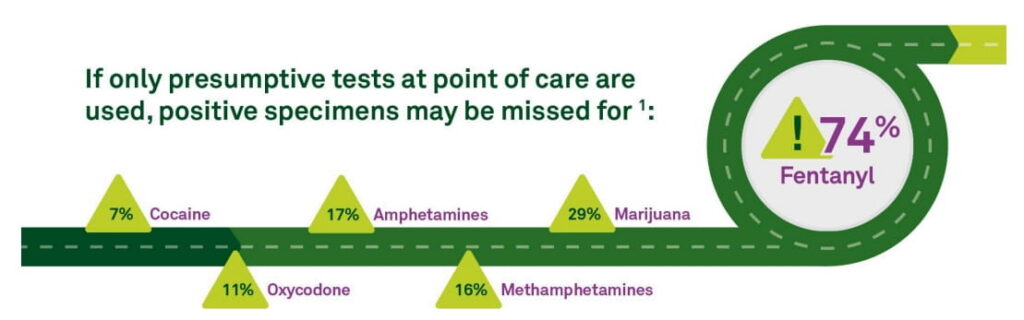 Fortunately, the current administration has been systematically ramping up efforts to dismantle synthetic fentanyl trafficking.[43] As recently as last week, President Trump announced the inaugural “Fentanyl Free America Summit” that brought together more than 3,000 members of law enforcement and other stakeholders to strategize the disruption of illicit fentanyl supply chains.[44]In terms of medical necessity, we respectfully point out that, depending on the specific facts of a case, it may be irresponsible for a pain management provider to limit its review to the results of presumptive urine drug testing alone. Doing so could endanger both the patient and the community.Regarding medical necessity, if direct-to-definitive testing is appropriate because of the significant risks of fentanyl abuse in a community, you may ask whether presumptive testing is also necessary. The answer is “Yes.” Only presumptive urine drug testing includes specific gravity testing. Specific gravity testing helps pain management providers determine whether a sample has been diluted, either by accident or to produce a false negative. Therefore, ordering such tests is essential to ensure test result integrity.
 -
Financial Incentives in Testing. Pain management practices that refer urine drug testing to outside reference laboratories face substantial Anti-Kickback Statute exposure whenever the laboratory provides anything of value to the practice in connection with those referrals. The Anti-Kickback Statute makes it a federal felony to knowingly and willfully offer, pay, solicit, or receive any remuneration—directly or indirectly, in cash or in kind—to induce or reward referrals of items or services reimbursable by a federal health care program.[45]One of the most common examples of Anti-Kickback Statute exposure in the pain practice management context involves laboratories providing free point-of-care drug testing cups, conditioned on the practice's agreement to return urine specimens to the laboratory for expensive confirmatory testing. The government has consistently treated this arrangement as an illegal kickback. Beyond free point-of-care urine drug testing cups, laboratories have also been found to have paid illegal remuneration in the form of cash, speaker fees, gift cards, and other items of value in exchange for urine drug testing referrals.
D. Controlled Substance Prescribing and DEA Compliance. Prescribing controlled substances exposes pain physicians to criminal, civil, and administrative liabilities under the CSA and state laws.
-
Legitimate Medical Purpose and Usual Course of Practice. Under 21 C.F.R. § 1306.04, prescriptions must be issued for a legitimate medical purpose by a practitioner acting in the usual course of professional practice. Prescribing outside accepted medical norms, prescribing dangerous combinations (e.g., the "Holy Trinity" of improperly prescribing combinations of opioids, benzodiazepines, and skeletal muscle relaxants),[46] or operating a "pill mill" are primary triggers for DEA enforcement.
-
Prescription Drug Monitoring Programs (PDMP). The Prescription Drug Monitoring Program (PDMP) is one of the most powerful tools available to prescribers for identifying patients who are obtaining controlled substances from multiple providers, exhibiting drug-seeking behavior, or receiving dangerous combinations of opioids and other central nervous system depressants. A physician's failure to consult the PDMP before prescribing controlled substances has become an increasingly prominent factor in state medical board disciplinary actions, civil malpractice litigation, and DEA administrative proceedings. Additionally, in criminal prosecutions of physicians for unlawful opioid distribution, the government has introduced PDMP data as direct evidence that: (1) A physician either knew or had reason to know that a patient was obtaining controlled substances from multiple sources; (2) A patient had tested positive for illicit drugs; or (3) A patient had exhibited clear signs of addiction and diversion. Despite one or more clear signs of abuse being present, the defendant physician still chose to prescribe controlled substances to the patient.
-
Telemedicine Prescribing. Prescribing opioids and other controlled substances via telemedicine is permitted under a framework of temporary regulatory flexibilities that have been repeatedly extended since the COVID-19 public health emergency. Under the DEA's Fourth Temporary Extension of COVID-19 Telemedicine Flexibilities, effective through December 31, 2026, DEA-registered practitioners may prescribe Schedule II through V controlled substances to patients they have never physically examined, provided the encounter occurs via a real-time audiovisual communication platform. However, relaxing the traditional in-person examination requirement has created substantial opportunities for abuse, which the DOJ and DEA have aggressively pursued. In the event of an investigation, law enforcement won’t merely limit its review to the telemedicine visit and evaluation; it will also examine whether the prescriber first checked the PDMP and whether the prescriber was under a financial arrangement with third-party pharmacies and testing laboratories.
-
Recordkeeping and Security. Every DEA-registered practitioner who dispenses, administers, or otherwise handles controlled substances is subject to comprehensive federal recordkeeping obligations under the CSA and its implementing regulations.[47] These requirements include maintaining a complete and accurate biennial inventory of all Schedule II through V controlled substances on hand, retaining all records for at least two years at the registered location in a readily retrievable manner, and promptly reporting any theft or significant loss of controlled substances to the DEA on Form 106. Failure to comply with these obligations is a federal violation that can trigger a cascade of administrative and criminal consequences. It is unlawful for any registrant to "refuse or negligently fail to make, keep, or furnish any record, report, notification, declaration, order or order form, statement, invoice, or information required" under the CSA.[48]
Please note that the controlled substance and opioid risks outlined in Sections A through C above are not an exhaustive list of concerns for pain management physicians and practices.
VI. Responding to an Audit of Your Pain Management Practices and Claims:
When law enforcement treats every opioid prescription as a possible crime scene, the patient becomes collateral damage. The law can punish the physician who illegally sells controlled substance prescriptions without turning every chronic pain patient into a suspect or every caring doctor into a defendant. Restoring that distinction is essential. In the meantime, the prescribing practices of pain management physicians are under intense scrutiny by federal prosecutors, DEA agents, law enforcement investigators, CMS program integrity contractors, and State Medical Boards. If your opioid and/or controlled substance prescribing practices are under review, we recommend that you contact experienced health care regulatory lawyers as soon as possible.
Are you dealing with an audit of your opioid or controlled substance prescribing practices? Schedule a free initial consultation with Liles Parker to discuss whether we can assist you. We can be reached at +1 (800) 475-1906 or +1 (202) 298-8750. Liles Parker is not your typical health care regulatory law firm. Our team includes former federal prosecutors, several of whom held significant positions at the U.S. Department of Justice, former HHS legal counsel, and experienced health care regulatory attorneys who hold certifications as Certified Professional Coders (CPC), Certified Medical Compliance Officers (CMCO), and Certified Medical Reimbursement Specialists (CMRS). The firm has been rated "AV" by Martindale-Hubbell — an honor described as "limited to only the most distinguished law practices," for over 20 years.


- [1] NCHS Data Brief, “Chronic Pain and High-Impact Chronic Pain in U.S. Adults.” (November 2024). https://www.cdc.gov/nchs/data/databriefs/db518.pdf
- [2] DOJ 2026 Takedown Case Descriptions. https://www.justice.gov/criminal/criminal-fraud/health-care-fraud-unit/2026-national-hcf-case-summaries
- [3] Id.
- [4] Id. at 459–60.
- [5] Id.
- [6] See 21 C.F.R. § 1306.04(a). Although applicable regulations state that the primary responsibility for proper prescribing lies with the practitioner, they also provide that there is "a corresponding responsibility that rests with the pharmacist who fills the prescription."
- [7] DEA Final Order titled “Established Aggregate Production Quotas for Schedule I and II Controlled Substances and Assessment of Annual Needs for the List I Chemicals Ephedrine, Pseudoephedrine, and Phenylpropanolamine for 2025.” 89 Fed. Reg. 102,649 (December 17, 2024). https://www.govinfo.gov/content/pkg/FR-2024-12-17/pdf/2024-30023.pdf
- [8] DEA Final Order titled “Established Aggregate Production Quotas for Schedule I and II Controlled Substances and Assessment of Annual Needs for the List I Chemicals Ephedrine, Pseudoephedrine, and Phenylpropanolamine for 2026.” 91 Fed. Reg. 287 (January 5, 2026). https://www.govinfo.gov/content/pkg/FR-2026-01-05/pdf/2025-24277.pdf
- [9] Phillip O. Coffin & Antje M. Barreveld, “Inherited Patients on Opioids for Chronic Pain—Considerations for Primary Care,” 386 New Eng. J. Med. 611, 611 (2022). https://pmc.ncbi.nlm.nih.gov/articles/PMC9555806/.
- [10] Id. at 612.
- [11] Press Release, Ctrs. for Disease Control & Prevention, “CDC Advises Against Misapplication of the Guideline for Prescribing Opioids for Chronic Pain” (Apr. 24, 2019). https://archive.cdc.gov/www_cdc_gov/media/releases/2019/s0424-advises-misapplication-guideline-prescribing-opioids.html.
- [12] U.S. Dep’t of Health & Human Servs., “HHS Guide for Clinicians on the Appropriate Dosage Reduction or Discontinuation of Long-Term Opioid Analgesics” 1–2 (Oct. 2019). https://www.hhs.gov/system/files/Dosage_Reduction_Discontinuation.pdf.
- [13] Deborah Dowell et al., “CDC Clinical Practice Guideline for Prescribing Opioids for Pain — United States,” 2022, 71 Morbidity & Mortality Wkly. Rep. Recommendations & Reports No. RR-3, 1, 2–3 (Nov. 4, 2022). https://www.cdc.gov/mmwr/volumes/71/rr/rr7103a1.htm.
- [14] Id. at 2.
- [15] Office of Inspector Gen., U.S. Dep't of Health & Human Servs., “Audits of Medicare Payments for Spinal Pain Management Services” (Series SRS-A-25-006). https://oig.hhs.gov/reports/work-plan/browse-work-plan-projects/srs-a-25-006/
- [16] CMS Local Coverage Determinations (LCDs) strictly limit the frequency of ESIs (e.g., the maximum number of sessions over a rolling 12-month period). Billing for injections that exceed frequency limits or failing to document a trial of conservative therapy is a major compliance risk.
- [17] Office of Inspector Gen., U.S. Dep't of Health & Human Servs., “Medicare Improperly Paid Physicians for Epidural Steroid Injection Sessions.” Report No. A-07-21-00618 (March 10, 2023). https://oig.hhs.gov/reports/all/2023/medicare-improperly-paid-physicians-for-epidural-steroid-injection-sessions/
- [18] Office of Inspector Gen., U.S. Dep't of Health & Human Servs., “Medicare Could Have Saved an Estimated $17.7 Million if CMS’s Oversight Had Prevented At-Risk Payments for Anesthesia Administered During Spinal Pain Management Procedures.” Report No. A-09-23-03013 (July 31, 2025). https://oig.hhs.gov/documents/audit/10845/A-09-23-03013.pdf
- [19] Ctrs. for Medicare & Medicaid Servs., Local Coverage Determination (LCD): Facet Joint Interventions for Pain Management (L33930). https://www.cms.gov/medicare-coverage-database/view/lcd.aspx?lcdId=33930&ver=49
- [20] For additional information om the Texas prosecution, see our article titled “An Overview of Administrative Rheumatology Audits / Adverse Actions AND Civil / Criminal Enforcement Actions.” (May 20, 2018).
- [21] Ctrs. for Medicare & Medicaid Servs., Local Coverage Determination (LCD): Spinal Cord Stimulators for Chronic Pain (L35136). https://www.cms.gov/medicare-coverage-database/view/lcd.aspx?lcdid=35136
- [22] Ctrs. for Medicare & Medicaid Servs., 0207-Spinal Cord Neurostimulation: Medical Necessity and Documentation Requirements, Approved RAC Topics (August 28, 2025). https://www.cms.gov/data-research/monitoring-programs/medicare-fee-service-compliance-programs/medicare-fee-service-recovery-audit-program/approved-rac-topics/0207-spinal-cord-neurostimulation-medical-necessity-and-documentation-requirements
- [23] Office of Inspector Gen., U.S. Dep't of Health & Human Servs., “Medicare Overpaid More Than $636 Million for Neurostimulator Implantation Surgeries.” Report No. A-01-18-00500 (October 2021). https://oig.hhs.gov/documents/audit/5847/A-01-18-00500-Complete%20Report.pdf
- [24] Ctrs. for Medicare & Medicaid Servs., Billing and Coding: Trigger Point Injections (TPI) (Article A59480). https://www.cms.gov/medicare-coverage-database/view/article.aspx?articleid=59480&ver=10&
- [25] Ctrs. for Medicare & Medicaid Servs., Local Coverage Determination (LCD): Trigger Point Injections (L35010). https://www.cms.gov/medicare-coverage-database/view/lcd.aspx?LCDId=35010
- [26] In May 2025, the OIG released a massive audit report focusing on Medicare payments for E/M services billed with Modifier 25 on the same day as intravitreal (eye) injections. The audit revealed that for 42 percent of all injections provided during the 12-month audit period, providers also billed a same-day E/M service using Modifier 25. Office of Inspector Gen., U.S. Dep't of Health & Human Servs., “Medicare Payments for Evaluation and Management Services Provided on the Same Day as Eye Injections Were at Risk for Noncompliance With Medicare Requirements.” Report No. A-09-23-03014 (May 27, 2025). https://oig.hhs.gov/documents/audit/10286/A-09-23-03014.pdf
- [27] 42 C.F.R. §410.26(a)(1).
- [28] 42 C.F.R. §410.26(b)(7).
- [29] Id.
- [30] The rules of each state must be reviewed. Texas has adopted a modified approach. For example, in Texas, NPs and PAs generally do not need a document called a “collaborative agreement,” but they do need physician-linked delegation/supervision arrangements to perform delegated medical acts and, if applicable, to prescribe. For prescribing, Texas requires a prescriptive authority agreement (PAA) between the physician and the APRN or PA, and the delegating physician must register the delegation with the Texas Medical Board. For physician assistants specifically, Texas law also requires continuous supervision by a supervising physician, though not constant on-site presence. In summary: (1) Nurse Practitioners / APRNs: Texas is not a full independent-practice state for APRN prescribing. If an NP is exercising delegated prescriptive authority, the NP must practice under a Tex. Occ. Code § 157.0512 prescriptive authority agreement with a physician and within delegated authority under Texas law; (2) Physician Assistants: A PA must be supervised by a physician under Texas law, and if the PA is prescribing, must also have a Tex. Occ. Code § 157.0512 prescriptive authority agreement and related delegation registration.
- [31] 42 C.F.R. §410.26(b)(2).
- [32] Medicare Benefit Policy Manual, Chapter 15, Section 60.2. Services of Nonphysician Personnel Furnished Incident-To Physician’s Services. https://www.cms.gov/Regulations-and-Guidance/Guidance/Manuals/Downloads/bp102c15.pdf
- [33] 42 C.F.R. §410.26(b)(3).
- [34] 42 C.F.R. §410.26(b)(3).
- [35] 42 C.F.R. §410.26(a)(2).
- [36] 42 C.F.R. §410.26(b)(4).
- [37] Medicare Benefit Policy Manual, Chapter 15, Section 60.1 defines "incident to" as services furnished as an integral, incidental part of the physician's personal professional services in the course of diagnosis or treatment of an injury or illness. The key operative language is in the Direct Personal Supervision subsection (§ 60.1B): "This does not mean, however, that to be considered incident to, each occasion of service by auxiliary personnel (or the furnishing of a supply) need also always be the occasion of the actual rendition of a personal professional service by the physician. Such a service or supply could be considered to be incident to when furnished during a course of treatment where the physician performs an initial service and subsequent services of a frequency which reflects his/her active participation in and management of the course of treatment." Additionally, Section 60.2, which governs nonphysician practitioners (NPs, PAs, etc.), reinforces this directly: "It does mean that there must have been a direct, personal, professional service furnished by the physician to initiate the course of treatment of which the service being performed by the nonphysician practitioner is an incidental part, and there must be subsequent services by the physician of a frequency that reflects the physician's continuing active participation in and management of the course of treatment." The implications are clear. Since incident-to billing requires a pre-existing "course of treatment" that the physician personally initiated, it cannot apply to the patient's first (initial) visit, because no course of treatment has yet been established. There is no prior physician service to which the nonphysician's service can be "incidental."
- [38] Multiple Medicare Administrative Contractors (MACs) have codified this principle explicitly: Noridian Medicare (Jurisdictions E and F) states in its incident-to guidance: "Billing 'incident to' the physician, the physician must initiate treatment and see the patient at a frequency that reflects his/her active involvement in the patient's case. This includes both new patients and established patients being seen for new problems." https://med.noridianmedicare.com/web/jeb/topics/incident-to-services. CGS Medicare (Jurisdictions 15 and H) states in its Incident-To Fact Sheet: "'Incident to' services cannot be rendered on the patient's first visit, or if a change to the plan of care occurs." https://cgsmedicare.com/partb/mr/pdf/incident_to_provision_factsheet.pdf.
- [39] For an early history of incident-to billing, see our article titled “Incident-To Billing Practices are Under Law Enforcement’s Microscope, Are Your Incident-To Practices Compliant.” (September 20, 2022).
- [40] Office of Inspector Gen., U.S. Dep't of Health & Human Servs. ”Medicare Could Have Saved Up to $216 Million Over 5 Years if Program Safeguards Had Prevented At-Risk Payments for Definitive Drug Testing Services.” Report A-09-21-03006 (February 2023). In 2023, the OIG identified up to $216 million in potential Medicare overpayments for definitive drug testing (e.g., HCPCS G0483 for 22+ drug classes) billed without individualized medical necessity.
https://oig.hhs.gov/documents/audit/9626/A-09-21-03006-Complete%20Report.pdf - [41] OIG Report A-09-20-03017, supra note 51.
- [42] Way Back Machine, Quest Diagnostics, “Presumptive Versus Definitive Drug Testing,” https://web.archive.org/web/20240816003122/https://www.questdiagnostics.com/healthcare-professionals/about-our-tests/drug-testing/presumptive-versus-definitive
- [43] The current administration has implemented a variety of measures to eradicate the illegal importation and trafficking of fentanyl and other synthetic opioids. Examples of the measures taken are discussed in the Press Releases below:
- White House Press Release, “Fact Sheet: President Donald J. Trump Closes De Minimis Exemptions to Combat China’s Role in America’s Synthetic Opioid Crisis.” (April 2, 2025).
https://www.whitehouse.gov/fact-sheets/2025/04/fact-sheet-president-donald-j-trump-closes-de-minimis-exemptions-to-combat-chinas-role-in-americas-synthetic-opioid-crisis/ - White House Press Release, “President Trump Signs HALT Fentanyl into Law.” (July 16, 2025). https://www.whitehouse.gov/releases/2025/07/president-trump-signs-halt-fentanyl-act-into-law/
- White House Press Release, “Fact Sheet: President Trump Designates Fentanyl as a Weapon of Mass Destruction.” (December 15, 2025). https://www.whitehouse.gov/?s=fentanyl
- White House Press Release, “President Trump’s Relentless Strategy is Dismantling Fentanyl Networks and Saving Lives.” (July 13, 2026). https://www.whitehouse.gov/releases/2026/07/president-trumps-relentless-strategy-is-dismantling-fentanyl-networks-and-saving-lives/
- White House Press Release, “Fact Sheet: President Donald J. Trump Closes De Minimis Exemptions to Combat China’s Role in America’s Synthetic Opioid Crisis.” (April 2, 2025).
- [44] Drug Enforcement Administration, “Fentanyl Free America – Summit 2026.” https://www.dea.gov/fentanyl-free-summit
- [45] 42 U.S.C. § 1320a-7b(b).
- [46] Horsfall JT, Sprague JE. “The Pharmacology and Toxicology of the 'Holy Trinity'.” Basic & Clinical Pharmacology & Toxicology (February 2017).
- [47] See 21 C.F.R. Part 1304.
- [48] 21 U.S.C. § 842(a)(5).
You must be logged in to post a comment.