
(January 13, 2026): As the great Yogi Berra once said, “It’s tough to make predictions – especially about the future.” This maxim is especially true when it comes to forecasting the specific dental claim risk issues that will be the focus of private payor Special Investigation Units (SIUs) in 2026. Nevertheless, we are going to give it shot. In this article, we are going to look at the proverbial 800-pound gorilla of dental benefits – the Delta Dental Plans Association. The association is comprised of 39 independent Delta Dental companies (Delta Dental). The Delta Dental Plans Association is the undisputed biggest dental benefits provider in the country. Collectively, these Delta Dental companies insure more than 80 million individuals. Approximately one in three of all Americans who have dental insurance are covered by Delta Dental. Not surprisingly, each of the 39 independent Delta Dental companies have established SIUs that are tasked with identifying and pursuing dental providers that may be engaging in fraud, waste, and/or abuse. In this article, we examine the types of dental claims errors and business practices that have been pursued by Delta Dental SIUs around the country. We will also cover new areas of interest that are likely to give rise to a Delta Dental investigation. Finally, we will discuss how you should respond if your practice is the subject of a Delta Dental audit.
I. Delta Dental Audit Outlook for 2026:
Based on their enforcement efforts in 2024 and 2025, Delta Dental looks poised to adopt an even more proactive and technologically advanced approach to fraud prevention and enforcement in 2026. Although there are several common, recurring dental fraud schemes that auditors will continue to see, technology and the expansion of artificial intelligence (AI) have led to the use of new and innovative improper coding and billing practices. Delta Dental has recognized the need for robust strategies that not only detect but also deter fraudulent activities before they impact members, providers, and the overall integrity of its payor network.
-
The Impact of Artificial Intelligence (AI) on Delta Dental Audit Activity.
As early as 2022, Delta Dental of New Mexico, engaged NovoHealth® Dental to perform payment integrity, automatic claim quality assessments, provider outlier detections, and disease assessments. As NovoHealth’s CEO has stated:
"By processing claims with our AI platform, analysts can quickly identify fraudulent, abusive or wasteful practices, which will save patients, providers and payors time and money," [1]
Not surprisingly, other Delta Dental companies have followed in New Mexico’s footsteps and incorporated AI tools into their fraud detection and prevention efforts. By leveraging these cutting-edge technologies, Delta Dental has moved beyond traditional, reactive methods—such as manual claim reviews, towards a predictive model that flags outliers in real time. We anticipate that Delta Dental claims audits in 2026 will be primarily driven by "predictive risk scoring.”[2] Additionally, we expect the audits initiated to be faster since the lag period between the submission of a claim and the time it takes to initiate an audit will be shortened. The time between the submission of records and the issuance of audit results is also expected to be reduced using AI to assist with speeding up the review process. Finally, the results of AI audits are likely to be more standardized in terms of clinical decisions reached when analyzing a dentist’s patient treatment notes.
-
Delta Dental Administers Numerous Types of Plans Performs a Variety of Audits.
It is important to remember that the 39 Delta Dental companies perform a wide variety of services, ranging from offering direct-to-consumer dental insurance to serving as administrator for state Medicaid dental plans. Although Delta Dental has not publicly disclosed a breakdown of its plan coverage, it is believed that private and employer-sponsored dental plans make up the largest percentage of its overall business. Delta Dental also manages many states’ Medicaid dental programs and has actively moved into the Medicare Advantage market, where it is managing the payors’ dental claims for Part C Medicare payor plans. As a result of this diversity, there is a significant likelihood that one or more categories of your dental claims will be audited in 2026.
II. Factors that Can Trigger a Delta Dental Audit:
Audit letters seem to show up when they are least expected. While the letter from Delta Dental may state otherwise, virtually no dental claims audits are “routine.” Using predictive risk scoring There are a variety of factors that may trigger an audit of your Delta Dental claims. For instance:
-
AI is Conducting a Real-Time Analysis of Your Dental Claims.
The days of “pay and chase” are behind us. Delta Dental and other private payors are using AI to assess claims and initially assign a risk score at the time of submission. A provider’s current dental business practices, coupled with AI’s assessment of a provider’s prior coding and billing history, can result in a dental practice being flagged for audit or investigation by Delta Dental’s SIU. Some of the facts reviewed by AI include:
- Billings per patient. How do the current and historical total billings per patient compare with those of other dental providers?
- Number of services per patient. How do the current and historical number of services per patient / per visit, compare with those of other dental providers?
- Percentage of high-end treatment services. Delta Dental auditors examine the percentage of high-end treatment services (such as crowns, onlays, and scaling/root planing) primarily to identify aberrant utilization patterns that differ significantly from those of their peers in other dental practices. Medical necessity is one of the primary issues examined in an audit of complex, expensive dental procedures.
-
Adverse Actions Taken Against a Participating Dentist.
Check your Delta Dental participation agreement. You are likely to have an affirmative, contractual obligation to notify the payor of any changes or “adverse actions”[3] that may affect your eligibility to remain a participating provider. For example:
- State Dental Board actions. Actions taken by a State Dental Board against a licensee, both disciplinary actions and non-disciplinary actions (such as the imposition of a remedial improvement plan, letter of warning, requiring a monitor of the licensee’s dental services), are often considered by Delta Dental to be an adverse event that necessitates review and possible action by the payor.
- Complaints against a dentist or dental practice. Delta Dental takes patient complaints quite seriously and regularly responds to these complaints by initiating audits and investigations.
- Actions taken by federal and state prosecutors and regulators. Delta Dental monitors both civil settlements and criminal prosecutions of dentists and their practices. When an adverse action is announced, the SIU will typically follow in the wake of the government’s investigation and initiate a collateral audit of similar dental services.
- Reports published on the National Practitioner Databank (NPDB). Delta Dental and other insurance payors are required to report certain adverse actions against practitioners for inclusion in the NPDB within 30 days. These insurance companies have access to the NPDB and regularly access the database when performing credentialing actions, reviewing a dentist’s history of dental malpractice settlements, and to check if a dentist has been subject to any adverse licensure actions.
Ultimately, AI and Delta Dental SIUs continuously slice-and-dice every aspect of the dental claims submitted to the payor for reimbursement. The real-time analysis of claim amounts, frequency of billings, complexity of the procedures rendered, and the ancillary services billed are all assessed. Targets are flagged, and dental practices are audited.
III. Dental Claim Risk Areas Targeted by Delta Dental Companies Around the Country:

In some respects, Delta Dental has been monitoring dental claims and detecting fraud for a longer period than many of the federal and state governments with whom they work. Delta Dental’s roots go back to 1954. At that time, a number of dentists groups and unitions in California, Oregon and Washington state formed a nonprofit Dental Service Organization (DSO) to increase patient access to dental care. This led to the establishment of the Delta Dental Plans Association in 1966. Regardless of its name at the time, Delta Dental and its forebearers have more than 70 years’ experience processing dental claims and identifying those services that are improperly billed or fraudulent.[4]
In 1964, when the Medicare and Medicaid programs were passed by Congress and signed into law by President Lyndon B. Johnson,[5] dental services were planned, but not yet offered by Medicaid. It was not until 1967 that Medicaid included a set of dental benefits for children under the age of 21. This program was known as the “Early and Periodic Screening, Diagnostic and Treatment” (EPSDT) benefit. Now that federal and state funding was involved, more scrutiny was given to the dental claims being paid by the government.
Over the years, many states expanded the scope of their Medicaid dental programs to also cover the dental needs of needy adults. Although dental coverage is generally excluded from coverage under Medicare Part B, all Medicare Part C, Medicare Advantage plans now offer dental coverage for their eligible beneficiaries.
If one or more the audit triggers identified in Section II results in the initiation of a Delta Dental audit, the payors’ SIUs are trained to identify a wide range of improper business practices. The primary dental claim risk issues that have been identified by Delta Dental and/or its law enforcement partners in audits we have seen include, but are not limited to:
-
Failure to Charge Delta Dental the Practice’s Usual Fee.
Check your participating provider agreement with Delta Dental. More than likely, it includes a provision which mandates that participating providers do not charge Delta Dental fees that are higher than the usual fees charged to non-Delta Dental patients. For example, in recent years, we have seen several Delta Dental of New Jersey audits where the participating dental practice was alleged to have violated this contractual requirement. Notably, Delta Dental has often based this contention on the amounts charged to, and collected from, uninsured patients or through an in-office membership plan. As Delta Dental of New Jersey’s website expressly provides:
"Usual Fee - Participating dentists must file their “usual” fees as defined in the Bylaws of Delta Dental of New Jersey, Inc. “Usual” fee is the fee that the dentist most frequently actually charges to and collects from his/her uninsured patients as payment in full, less any discount which is regularly offered to patients, other than a discount which reasonably reflects the time value of money. (i.e., where the amount of the discount is essentially the same as the amount of interest that the dentist would reasonably expect to earn by receiving the payment on an accelerated basis). For purposes of this regulation “uninsured” means without dental coverage, but exclusive of patients covered by governmental assistance programs such as Medicaid.
Uninsured means without dental coverage, but exclusive of patients covered by governmental assistance programs such as Medicaid.” [6] (Emphasis Added).
-
Billing for Dental Services Not Rendered.
Dental audits by the SIU have regularly alleged that one or more of the dental services or procedures billed to Delta Dental were not provided. While there were undoubtedly instances when the services were improperly billed, our reviews often found that the services were, in fact, provided, BUT the services were not properly documented. Allegations of this type are especially problematic. Billing for services not rendered may constitute fraud and can lead to civil and/or criminal liability. Additionally, this conduct can result in significant disciplinary action by the New Jersey State Board of Dentistry. In contrast, if a provider can show that the dental services were provided, but were poorly documented, it would likely be treated as an overpayment, not as fraud. Moreover, the New Jersey Board of Dentistry is likely to order remedial records training rather than seek to impose more severe licensure sanctions.
-
Billing for Services Rendered by Non-Credentialed Dentists.
Under the terms of many Delta Dental agreements with participating providers, participating dentists are not permitted to submit claims to the payor for services performed by dentists who are not credentialed with Delta Dental on the date of service at issue. For example, this billing practice is not permitted by Delta Dental of New Jersey.[7] In other words, Delta Dental of New Jersey does not recognize “Incident To” billing. While incident to billing is generally a Medicare concept, a limited number of Medicaid and private payor medical and dental payor programs permit incident to billing if the other requirements of incident to billing have been met.[8] Check your participation agreements!
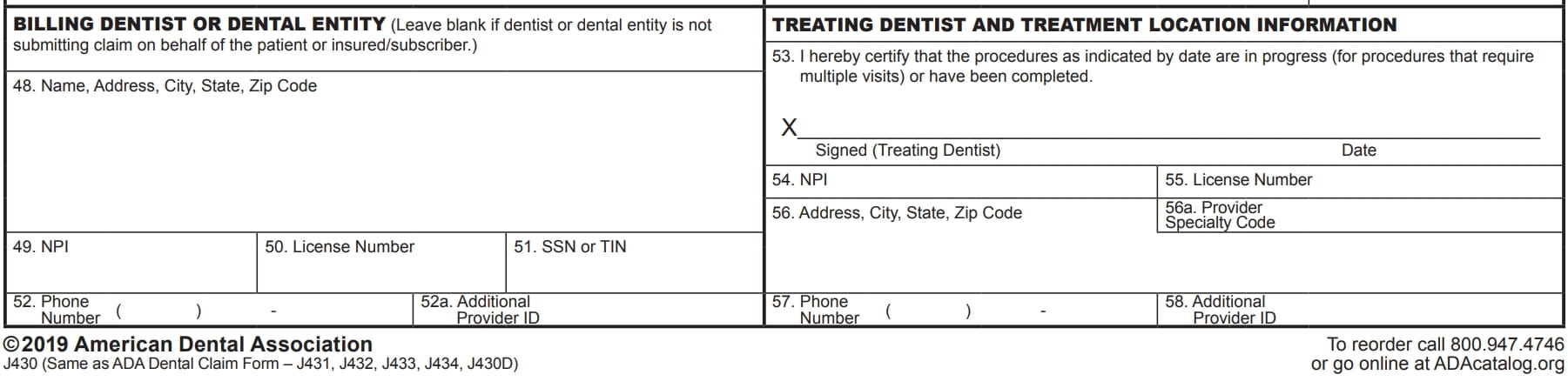
As the American Dental Association’s® (ADA’s®) Dental Claim Form reflects, dental practices are supposed to disclose the identities of both the “billing dentist” and the “treating dentist.” The improper billing for dental services performed by a non-credentialed dentist will show up here.
-
Failure to Report Patient Discounts.
Once again, dentists should review their participating provider agreement with Delta Dental. To the extent that the practice extends a discount to a patient, it must be properly reported on the claims form submitted to Delta Dental.
-
Failure to Collect Copayments and Deductibles.
Without exception, all Delta Dental provider agreements mandate that participating providers make reasonable efforts to collect patient copayments and deductibles. There are a number of reasons why it is important to collect patient cost sharing amounts. Delta Dental considers the routine waiver of copayments and deductibles as a breach of your contractual obligations and a form of fraud. While we have not seen a State Board of Dentistry base disciplinary action solely on a provider’s failure to collect copayments and deductibles, this conduct is still problematic. The State Board could consider it to constitute overbilling of the insurer, unfair competition, and/or a violation of a dentist’s professional obligations. As the ADA’s ® “Principles of Ethics & Code of Professional Conduct” [9] provides:
“5.B.1. WAIVER OF COPAYMENT. A dentist who accepts a third party[10] payment under a copayment plan as payment in full without disclosing to the third party that the patient’s payment portion will not be collected, is engaged in overbilling. The essence of this ethical impropriety is deception and misrepresentation; an overbilling dentist makes it appear to the third party that the charge to the patient for services rendered is higher than it actually is.”
-
Misrepresenting Treatment Dates on Claims Submitted.
Unfortunately, this has been a problem identified by Delta Dental SIUs around the country. Participating dentists have been alleged to have modified the date of service so that it qualifies as covered. Similarly, the payor may allege that the date of service was altered so that it would not fall under the patient’s new deductible for the year. Treatment date discrepancies may also occur when a practice bills for multi-stage dental procedures. Typically, dental providers must only bill for completed stages of a procedure, not for future work. However, you should carefully review the guidance issued by your Delta Dental to ensure that billing is compliant, as the correct time to bill for a multi-stage dental procedure, like the placement of a crown, can vary between the prep or seat date depending on the payor. If a provider bills for the wrong date, Delta Dental can allege an overpayment has occurred and may try to refuse to pay for any part of the service. Therefore, it is very important that you do not assume that you know how to bill for a service without first reviewing the provider handbook applicable to the Delta Dental being billed.
-
Failure to Submit Records Requested by Delta Dental.
It is surprising how often a participating provider either fails to answer an audit request OR fails to submit a complete set of responsive dental records when replying to Delta Dental’s audit letter. Understandably, at a minimum, Delta Dental will deny payment for any claims that cannot be supported by patient dental records. In cases where this occurred, Delta Dental may also seek to terminate a provider’s contract. Delta Dental may also report the lack of dental records to the State Board of Dentistry, who will often then conduct their own investigation. Depending on the facts, the payor may consider this conduct to constitute fraud and may refer the matter to federal or state prosecutors for their review and consideration as well.
-
Improper Dental Business Practices Involving Radiographs.
Radiographs have been a continuing area of concern in Delta Dental audits around the country. Radiograph-related problems that we have seen have included the following:
- Failure to submit supporting radiographs may be an indication of improper billing or fraud. For example, when conducting a post-payment audit of a participating provider who has billed for multiple root canal procedures, Delta Dental will typically request copies of the pre-operative and post-operative periapical radiographs related to each of the endodontic procedures billed.[11] Although Delta Dental is likely to treat isolated instances of a dental provider’s failure to submit requested radiographs as a mere overpayment, repeated failure of a dentist to submit requested radiographs will be viewed by Delta Dental’s SIU as evidence of fraud. This can lead to the termination of a provider’s participation in the plan. It may also result in a referral to federal and/or state law enforcement authorities for their review and prosecution for fraud.
- Radiograph reviews reflect that the level of dental service billed was not medically necessary. A typical scenario where Delta Dental would review patient radiographs to confirm the appropriateness of the billed service is when a dentist submits a claim for periodontal scaling and root planing (SRP, CDT codes D4341 or D4342). Upon receipt of the radiographs requested, Delta Dental will examine the images to verify the presence of bone loss, which is required to justify this higher level of periodontal treatment. If the radiographs do not show sufficient bone loss, the claim may be denied or downcoded to a less extensive procedure, such as a prophylaxis or gingivitis treatment.
- Delta Dental has repeatedly identified instances where a provider has improperly submitted the radiographs taken of one patient to justify the dental services performed on a different patient. Delta Dental’s adoption of AI technologies has made it quite easy for the payor to identify instances where a specific patient’s radiographs have been previously submitted, and the same radiographs have subsequently been submitted by a provider in connection with a different patient. While an isolated instance of this occurring may be a mistake, repeated instances will be construed by the payor as evidence of fraud.
- Delta Dental has identified cases where the patient radiographs submitted to the payor for review appear to have been improperly digitally altered by someone at the dental practice. Once again, Delta Dental’s use of AI can be used by the payor to identify irregularities in the radiographs that may be an indication that someone has altered the images, timestamps, or other data elements. For example, the AI system may identify abnormal changes in grayscale or anatomical features that are irregular. If an electronic version of the radiograph is reviewed, AI can also examine the metadata associated with the image to see if the provider has made changes to the original file. After reviewing the evidence, if Delta Dental concludes that a provider has improperly altered, or attempted to alter a radiograph, the payor will terminate the provider’s participation in the plan. Improper conduct of this type is likely to be referred to federal and/or state authorities for possible prosecution along with the State Board of Dentistry for further action.
- Delta Dental has alleged that the dental provider overutilized the use of radiographs in the care and treatment of a patient. In an audit, Delta Dental will review each patient’s dental records to identify why radiographs were taken. Radiographs should not be taken on a routine basis or just because insurance coverage is available, and the provider must document the medical necessity of each radiograph that is taken. If the dental record does not document why the radiographs were needed, the claims will be denied. Furthermore, Delta Dental has referred providers to their State Dental Board, alleging that the provider exposed patients to unnecessary radiographs.
-
Delta Dental alleges that the dental services billed were more expensive than the dental services documented in the patient’s dental records.
In an audit, Delta Dental will review each of the services and/or procedures billed to the payor on an ADA Dental Claim. If the services are not supported in the patient’s dental record, Delta Dental will either downcode the claim or deny the entire claim.
-
Delta Dental does not cover procedures and restorations that are performed for cosmetic purposes.
A dental provider may perform a restoration, such as a crown, veneer, or filling—because it is medically necessary to restore tooth function, structure, or health (for example, due to decay, fracture, or trauma). However, Delta Dental may allege that the primary purpose of the work was cosmetic and therefore did not qualify for coverage.
-
Delta Dental alleges that the dental provider improperly altered a patient’s dental records.
One of the fastest ways to be accused of wrongdoing is for a dental provider undergoing a claims audit to improperly alter a patient’s dental records. We have seen multiple instances where a dental provider made changes to a patient’s dental records but failed to properly note when the changes and/or supplemental information was added to a record. Dental payor auditors (including those from Delta Dental) now regularly request an electronic copy of patients’ dental records. The auditors then often request an audit trail which allows them to review the metadata to determine if changes to the patients’ dental records were made after the payor initiated an audit. Depending on the facts, undisclosed changes to the dental records can lead to the termination of a dental provider’s participation in the payor’s dental program. It can also lead to referrals by the payor to the provider’s State Dental Board and/or law enforcement.
-
Misrepresentation of a non-covered service.
We have seen multiple cases (both dental and medical) where the service billed was NOT the actual service performed. To the extent that the dental service actually performed did not qualify for coverage, payors tend to allege that it was improperly billed on purpose by the dental provider in order to get the service covered and paid. This type of conduct can lead to allegations of fraud and can result in referrals to both the State Board of Dentistry and federal/state law enforcement authorities.
IV. Responding to a Delta Dental Audit:
When you first learn of a Delta Dental audit, we strongly recommend that you contact a qualified health law who is experienced in defending dentists and their practices in private payor and government audits and investigations. Unfortunately, most dental providers are unaware of the many contractual, regulatory, and legal pitfalls that can place their practice (and sometimes their personal liberty) at risk. The health law attorneys at Liles Parker who would work on your matter have also passed the arduous requirements to become Certified Professional Coders (CPCs). Our health lawyers understand both the fundamentals and the broader health law issues likely to arise in your case. Are your dental claims being audited by Delta Dental? Schedule a initial complimentary consultation with Liles Parker.

- [1] See NovoHealth’s article titled “NovoDynamics Helps Leading U.S. Dental Insurer Fight Fraud, Waste and Abuse.” (January 22, 2022).
- [2] “Predictive Risk Scoring” is a data-driven model used by AI systems to assess both real-time and historical data to predict the likelihood of fraud occurring in the future. In contrast, traditional risk assessment systems typically base their assessments almost exclusively on historical data.
- [3] In the context of a dentist’s contractual obligations with Delta Dental, an “adverse action” is generally considered to be any adverse event that is taken by another insurance payor, a regulatory body (such as a State Dental Board), a legal action (such as the filing of a dental malpractice case), a sanction by a regulatory body, or the imposition of a significant, negative finding by law enforcement. Check your participation agreement. The terms of these contractual agreements vary from state to state and payor to payor.
- [4] Almost a decade ago, we first wrote about Delta Dental claims audits on our website. For an early look at Delta Dental’s audit activities, see our article titled “Delta Dental Audits are Ongoing Around the Country. Are You Prepared?”
- [5] On July 30, 1965, President Lyndon B. Johnson signed the Social Security Amendments of 1965 into law, Public Law 89-97. This legislation established the Medicare and Medicaid programs.
- [6] See Delta Dental of New Jersey’s post on “Insurance Fraud Awareness.”
- [7] For additional guidance on this issue, see our article titled “The Dangers of Billing for the Services of a Non-Credentialed Dentist / Non-Participating Dentist.”
- [8] For additional guidance on this issue, see our article titled “Incident To Billing Practices are Under Law Enforcement’s Microscope. Are Your Incident To Billing Practices Compliant?”
- [9] See Section 5.B.1. Waiver of Copayment of the ADA’s ® Principles of Ethics & Code of Professional Conduct. (October 2024).
- [10] As set out in the ADA’s Principles of Ethics & Code of Professional Conduct provides: “A third party is any party to a dental prepayment contract that may collect premiums, assume financial risks, pay claims, and/or provide administrative services.” See Footnote 1. (October 2024).
- [11] Delta Dental will want to review both the preoperative and postoperative radiographs documenting the medical necessity of the endodontic procedure AND the fact that the root canal billed (CDT D3310 – D3330) was, in fact, performed by the participating provider.